Say you are trying to keep a windowsill full of Echeverias alive through a gray, overcast winter, and after reading three forum threads that all swore by the same “magic purple bulb,” you order one, screw it into a cheap clamp lamp, and leave it running from morning until you go to bed. A month later your rosettes are taller, paler, and stretched toward the ceiling instead of sitting flat and compact. The light was on the whole time. So why did the plant look worse, not better?
This is where grow light advice gets murky. There’s a lot of good information circulating about supplemental lighting for succulents, but it’s tangled up with just as much guesswork, outdated assumptions, and marketing spin. Let’s separate what a beginner typically believes about grow lights from what actually holds up once you look at how succulents use light.
Myth #1: Any LED Bulb Advertised as a “Grow Light” Will Work
The Beginner Assumption: If a product is labeled “grow light” and plugs into a regular lamp socket, it must be suited to the job. Brightness, as judged by the eye, equals effectiveness.
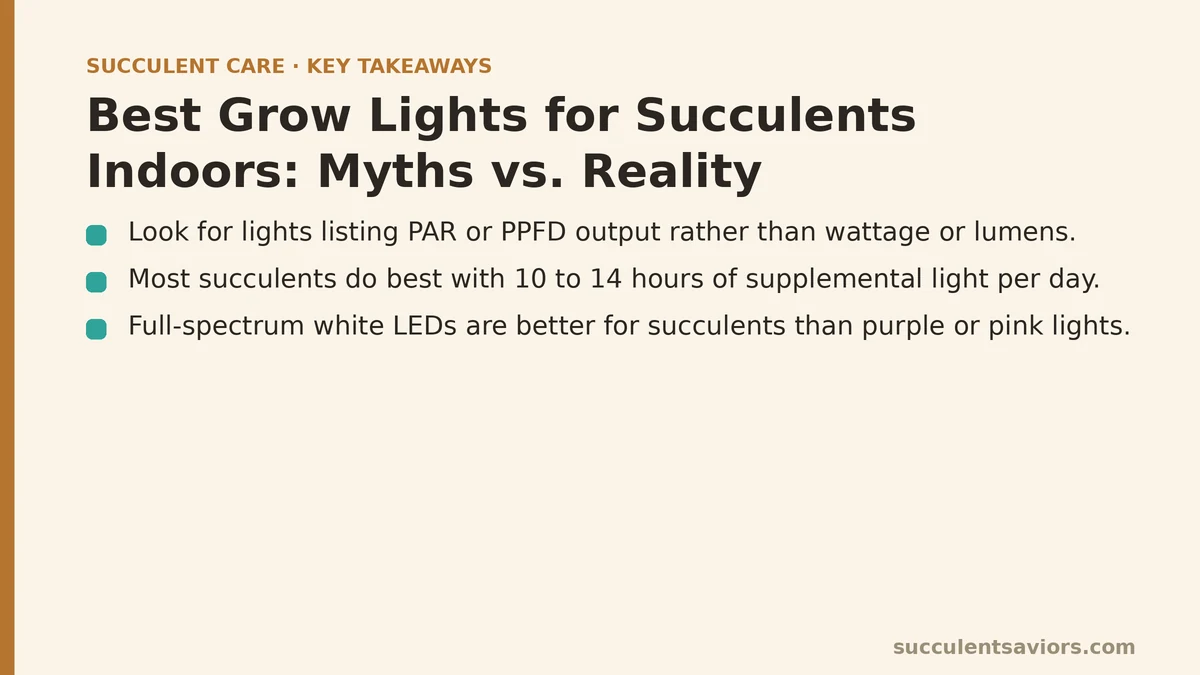
The Advanced Reality: Human eyes are terrible judges of light intensity for plant purposes. Our vision adjusts and compensates so well that a room can feel “bright” to us while still delivering only a fraction of the light intensity a succulent needs to stay compact. What matters is PPFD (Photosynthetic Photon Flux Density), a measurement of how many usable light particles are actually landing on the leaf surface. A dim-looking, full-spectrum LED panel positioned close to the plant can outperform a visually blinding bulb that’s mounted too far away or missing the wavelengths succulents rely on for photosynthesis. Look for lights that list PAR or PPFD output rather than just wattage or lumens, and don’t assume “bright to me” translates to “bright enough for a sun-loving succulent.”
Myth #2: More Hours of Light Always Means Healthier Plants
The Beginner Assumption: Since succulents love sun, running the grow light for 16, 18, even 24 hours a day should accelerate growth and prevent any chance of stretching.
The Advanced Reality: Succulents evolved with a day-night cycle, and that darkness period isn’t wasted time biologically—it’s when certain metabolic processes reset. Running lights around the clock can stress plants, disrupt their natural rhythms, and in some cases contribute to weaker, more fragile growth rather than stronger growth. Most succulents do best with 10 to 14 hours of supplemental light per day, mimicking natural daylight patterns, followed by a genuine period of darkness. A simple outlet timer removes the guesswork and prevents the common mistake of leaving a light on indefinitely because it’s easy to forget.
Myth #3: The Purple or Pink Glow Is a Sign the Light Is Working Properly
The Beginner Assumption: That distinctive violet-pink color coming from a grow light is proof it’s delivering exactly what plants need. The more intensely purple, the more powerful.
The Advanced Reality: That color comes from lights that emphasize only red and blue wavelengths while cutting out green, yellow, and much of the rest of the visible spectrum. Red and blue light are important for photosynthesis, but succulents, which evolved outdoors under full, unfiltered sunlight, tend to respond best to full-spectrum white light that includes a broader range of wavelengths. Full-spectrum LEDs won’t give you that dramatic purple glow, and to a beginner they can even look “less powerful” simply because they resemble ordinary daylight. Don’t let color become a stand-in for effectiveness—check the spectrum chart or PAR rating instead of judging by hue.
Myth #4: Grow Lights Are Only Necessary in Rooms With No Windows
The Beginner Assumption: If a room has a window, even a north-facing one, natural light should be sufficient, and a grow light is only for basements or interior offices.
The Advanced Reality: Window glass filters out a meaningful percentage of light intensity before it ever reaches the plant, and that filtering gets worse the farther the plant sits from the glass. A succulent six inches back from a bright window can be receiving dramatically less usable light than one pressed right against it. Add in winter’s shorter days, lower sun angles, and overcast weather, and even a south-facing windowsill often falls short of what a sun-loving succulent wants for eight or nine months of the year. Supplemental lighting isn’t a rescue tool reserved for dark rooms—it’s a routine part of keeping compact, colorful succulents anywhere that isn’t a true greenhouse.
Reading Your Plant’s Response: Beginner vs. Advanced Diagnosis
Symptom: New growth is pale, stretched, and leggy despite the grow light being on constantly.
Beginner’s Interpretation: “It’s growing fast, so the light must be doing its job.”
Advanced Understanding: Rapid, stretched growth under artificial light is almost always etiolation, meaning the plant isn’t receiving enough light intensity, even though the bulb is technically on. The fix usually involves moving the light closer to the plant, upgrading to a fixture with a stronger PPFD output, or both. Duration alone can’t substitute for adequate intensity.
Symptom: Leaves develop dry, papery, or bleached patches facing the light.
Beginner’s Interpretation: “My succulent must be getting too much light—time to move it far away or turn the lamp off.”
Advanced Understanding: This is light burn, and it typically happens when a strong grow light is placed too close, too suddenly, without an acclimation period. The solution isn’t to abandon supplemental lighting altogether; it’s to increase the distance between light and plant, or introduce the new light schedule gradually over one to two weeks so the plant’s tissue can adjust.
Symptom: The plant looks fine, but it never seems to produce vivid color or tight rosette form.
Beginner’s Interpretation: “Maybe this variety just doesn’t get colorful indoors.”
Advanced Understanding: Many succulents need a combination of high light intensity and a bit of environmental stress—cooler nights, drier soil—to trigger the pigments responsible for reds, purples, and oranges. A grow light alone, run in a warm, humid, unchanging environment, often produces green, healthy growth without the vibrant color a grower is hoping for. Pairing supplemental light with slightly cooler nighttime temperatures can make a noticeable difference.
Building Your Setup: Beginner Plan vs. Advanced Plan
| Consideration | Beginner Plan | Advanced Plan |
|---|---|---|
| Light Selection | Any bulb labeled “grow light” | Full-spectrum LED with a stated PPFD or PAR rating |
| Duration | Left on all day, or forgotten | 10–14 hours daily on a timer, mimicking natural daylight |
| Placement | Wherever it fits, distance ignored | Positioned based on the fixture’s tested light spread, adjusted as the plant grows |
| Acclimation | Full intensity from day one | Gradual introduction over 1–2 weeks to prevent light burn |
| Color Cues | Judged by the purple/pink glow | Judged by spectrum chart and measured output |
A Few Things Worth Trying This Week
If your succulents have been living under a light that’s on more out of habit than intention, a few small adjustments tend to make an outsized difference. Put the fixture on a timer instead of trusting yourself to remember. Move it a few inches closer if new growth looks stretched, or a few inches farther if you spot bleached patches after a recent change. And if you’ve been chasing that telltale purple glow, consider swapping in a full-spectrum bulb and watching how your plants respond over the following month—color and rosette tightness often tell you more than any spec sheet.
Which myth had you convinced before reading this—the idea that more hours of light is always better, or that the purple glow means the light is doing its job? Related guides: A Practical Q&A Guide to Propagating Succulents by Beheading, Crassula Perforata String of Buttons Care Guide: Separating Myth From Reality, and Do Succulents Flower? Understanding Blooming, Ranked by What’s Really Stopping Yours.