By the end of this guide, you’ll know exactly which succulents to plant together outdoors—and which pairings will quietly kill each other over the course of a single season. You’ll be able to walk into any nursery, look at the tags, and confidently assemble a group that shares the same watering rhythm, sun tolerance, and growth speed.
The Case That Started It: A Garden That Threw Its Neighbors Under the Bus
Last spring, a client called me out to her front yard. She had planted a gorgeous bed of Echeveria, blue chalk sticks, and a small jade tree. For two months, everything looked like a magazine spread. Then the rains came—two solid weeks of unseasonable downpour. The Echeveria rotted at the base within days, the blue chalk sticks stretched and flopped over, and only the jade tree came through looking smug and unaffected.
The problem wasn’t the rain. The problem was that she had mixed temperate-loving, rot-prone succulents with plants that could handle wet feet, and then topped it all with a species that wanted nearly full desert conditions. She needed a garden where every plant pulled in the same direction under stress, not just in perfect weather.
Here’s how we rebuilt it, and how you can build yours.
Step 1: Sort by Water Needs Before Anything Else
The first filter isn’t color, height, or aesthetic—it’s how much water each plant tolerates between soakings. Outdoor gardens take longer to dry out than indoor pots, because soil volume is larger and evaporation varies wildly with wind and shade. A plant that thrives with weekly water next to one that needs monthly water will end up with one happy and one drowning.
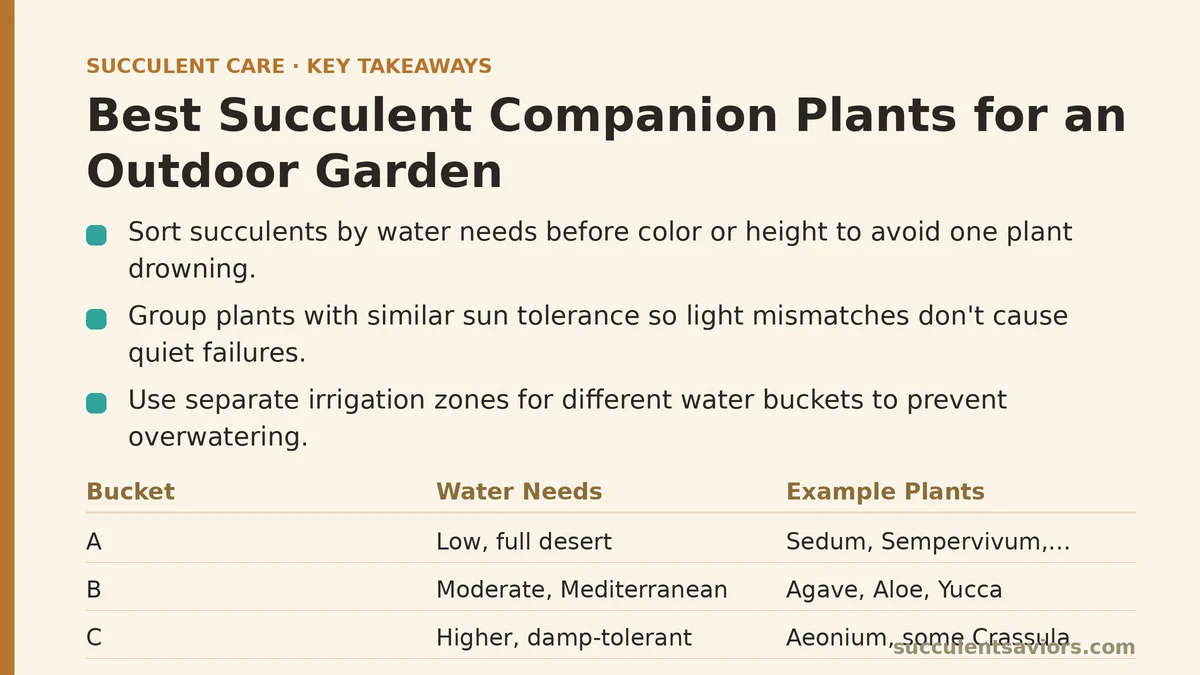
For outdoor planting, split your candidates into three buckets:
Bucket A: Low Water, Full Desert. These want deep, infrequent soaks and gritty soil that dries fast. Think Sedum, Sempervivum (hens and chicks), Delosperma (ice plant), and the tough, creeping Jovibarba. They’ll forgive you if the garden goes two weeks without irrigation.
Bucket B: Moderate Water, Mediterranean. These tolerate a bit more moisture and richer substrate. Agave, Aloe, and many Yucca fall here. They need drainage but won’t throw a tantrum if a summer thunderstorm dumps an inch overnight.
Bucket C: Higher Water, Tolerant of Occasionally Damp Soil. This is where Aeonium and some Crassula species live. They’d still rather be dry than soggy, but they handle a week of overcast drizzle without rotting as long as the soil isn’t clay.
In the client’s original bed, the Echeveria and blue chalk sticks were both Bucket B, but the jade tree was firmly Bucket A. The mismatch wasn’t the issue by itself—the real killer was that the entire bed was watered on the same timer. The jade got overwatered, the Echeveria got root rot, and the chalk sticks got etiolated from low light plus excess nitrogen in the wet soil.
Step 2: Match Sun Exposure Like You’re Matching Soil
Water isn’t the only shared resource. Sun tolerance runs the gamut from full-blast afternoon inferno to bright shade, and mismatched light causes more quiet failures than rot.
A common outdoor scenario: a south-facing strip near the house that bakes from noon to dusk. You can put Agave parryi, the compact artichoke agave, right in the hot zone. It laughs at 100°F reflected off a stucco wall. Pair it with Sedum kamtschaticum, a low, spreading groundcover that also handles the same glare. Both take full sun and dry soil. That’s a match.
But slide an Aeonium arboreum in there, with its ornamental dark rosettes, and you’ll watch it scorch. Aeonium wants afternoon shade in hot climates. If you plant it next to the agave, one of them is lying to you about its needs.
For the rebuild, we divided the front bed into two micro-zones. The west side, which catches the full afternoon sun, got the agave and sedum. The east side, shadowed by a fence from lunch onward, got the Aeonium and a few Crassula ovata cuttings. Same garden, two different light contracts.
Step 3: Control the Growth Rate Race
Companion planting fails most visibly when one plant’s vigor buries its neighbors. Outdoors, this happens faster than indoors because roots have unlimited room to roam and competition for light is constant.
Consider the classic pairing: Portulacaria afra (elephant bush) with a low Echeveria. Elephant bush is a fast, woody shrub that can add two feet in a single summer. It will shade the echeveria within weeks, etiolating it into a pale, stretched mess. Meanwhile, its aggressive root system will poach water from the soil before the smaller plant gets a sip.
Instead, put elephant bush with other upright, woody species—like Cussonia or the smaller Jatropha species—where its speed doesn’t matter because nobody is trying to grow beneath it. The ground level under it can stay bare gravel.
For layered planting, use the “spreader under a slow upright” rule. A rosette-forming succulent like Sempervivum tectorum, which spreads slowly by chicks, sits perfectly under a slow-growing, upright yarrow-leaved Aloe. The aloe gets height, the sedum gets ground cover, and neither outpaces the other’s reach for light.
Step 4: The Case Study Rebuild, Plant by Plant
Here’s the final layout we put in the ground, which has now survived two full summer with triple-digit heat and one freak hailstorm:
Zone 1, Hot and Dry (Western strip):
- Agave parryi as the structural anchor. It’s a medium agave, blue-gray, with a tight rosette. It gives the garden a permanent centerpiece that doesn’t move.
- Sedum spurium (dragon’s blood) as the groundcover. It creeps low, fills gaps with red-tipped foliage, and flowers pink in late summer. It doesn’t climb or shade the agave.
- Delosperma cooperi (hardy ice plant) threaded through the front edge. Its magenta blooms contrast the agave’s blue, and it thrives in the same gravelly, dry conditions.
Watering: once every three weeks in summer, then not at all from winter rain.
Zone 2, Afternoon Shade (Eastern strip):
- Aeonium arboreum ‘Zwartkop’ as the dark-leaved anchor. Its near-black rosettes stand out against the lighter zone.
- Sedum moranense tucked around its base. This creeping sedum tolerates the slightly richer soil the Aeonium prefers and adds a fine, mossy texture.
- Crassula capitella (campfire plant) along the front edge, where its stacked red leaves pick up the Aeonium’s dark tones.
Watering: every two weeks in summer, and the soil here is amended with extra coco coir to hold moisture a little longer than the sandy mix in Zone 1.
Step 5: Watch the Two Quiet Killers—Frost and Wind
Even perfect companions will fail if the site itself is hostile. Outdoor succulents die less from the wrong pair than from a frost pocket or a wind tunnel that dries the soil out faster than any root system can replace the moisture.
Hardy succulents—the Sempervivum, most Sedum, many Delosperma—can take a light freeze if the soil drains hard. Tender ones—the Aeonium, Echeveria, and Crassula—will turn to jelly at 32°F. Never mix the two in the same planting bed unless you’re prepared to cover the tender ones on cold nights.
Wind works differently. A constant, strong breeze accelerates soil evaporation and physically abrades leaves, turning them brown at the edges. If your garden sits on an exposed ridge, pick compact, low-growing species that hug the ground. Tall, columnar cacti or broad-leaved Aeonium will suffer indiscriminately, regardless of their companion.
In the client’s bed, we dug a shallow trench of large pebbles along the windward side. It broke the airflow near the ground, and it gave the garden a clean, finished edge.
Quick Reference: Outdoor Succulent Pairings by Site Condition
| Site Condition | Anchor Plant | Groundcover | Notes |
|---|---|---|---|
| Full sun, dry, sandy | Agave parryi | Sedum spurium | Water every 3 weeks, no amendment |
| Full sun, rocky slope | Yucca filamentosa | Delosperma cooperi | Both handle high drainage and reflected heat |
| Afternoon shade | Aeonium ‘Zwartkop’ | Sedum moranense | Amend soil with coir for slight moisture retention |
| Partial shade, sheltered | Crassula ovata (jade) | Sedum album | Jade tolerates the same moderate watering as this sedum |
| Coastal, windy | Sempervivum arachnoideum | Jovibarba heuffelii | Both stay low, minimizing wind damage |
What We Learned That You Can Apply Tomorrow
The original garden failed because it was planted as a grouping of individual favorites rather than a single, cooperative system. Every plant had distinct needs, and the same watering schedule and same sun exposure pushed three of them into a decline that looked like bad luck but was a design issue.
The rebuilt garden works because every plant in each zone shares a measurable tolerance range for water, light, and growth speed. The Agave and the Sedum dry out at the same rate. The Aeonium and the Crassula both handle a slightly richer soil. Nothing competes for light that can’t win. That’s companion planting in the practical sense—not just “these look pretty together,” but “these will survive together when the weather turns.”
What’s the pairing you’re currently trying to make work in your outdoor space—two plants you suspect have different water needs, or a sun-loving anchor that’s struggling next to a shade-tolerant neighbor?
Related guides: Succulent Gift Ideas: Best Varieties to Give (and the Care Kit to Match), Best Grow Lights for Succulents Indoors: Myths vs. Reality, and Best Pots for Succulents: Drainage Is Everything.