Here’s the part almost nobody expects: a healthy Burro’s Tail can drop dozens of leaves during a single move across a room, and that has nothing to do with poor care. The plant is simply built that way. Its leaves detach at the slightest touch, a trait botanists call “highly deciduous,” and that fragility is normal, not a symptom of neglect. Once you accept that, the rest of its care starts to make a lot more sense.
I want to walk through a specific plant to show how this plays out in real life. A customer brought in her Burro’s Tail last spring in a state she described as “molting itself to death.” Tracking her plant’s recovery over several months is a better teaching tool than a list of generic tips, because it shows how the plant’s odd behaviors connect to real causes and real fixes.
The Plant on Arrival: A Bald, Thinning Rope
Her Sedum morganianum had been growing in the same six-inch pot for three years, and it showed. The strands were long—nearly two feet—but sparse, with bare stem visible between clusters of plump, blue-green leaves. She’d been carrying it back and forth between a shaded porch and a sunny kitchen window every few days, trying to find the “right” spot, and each move left a trail of dropped leaves on the floor.
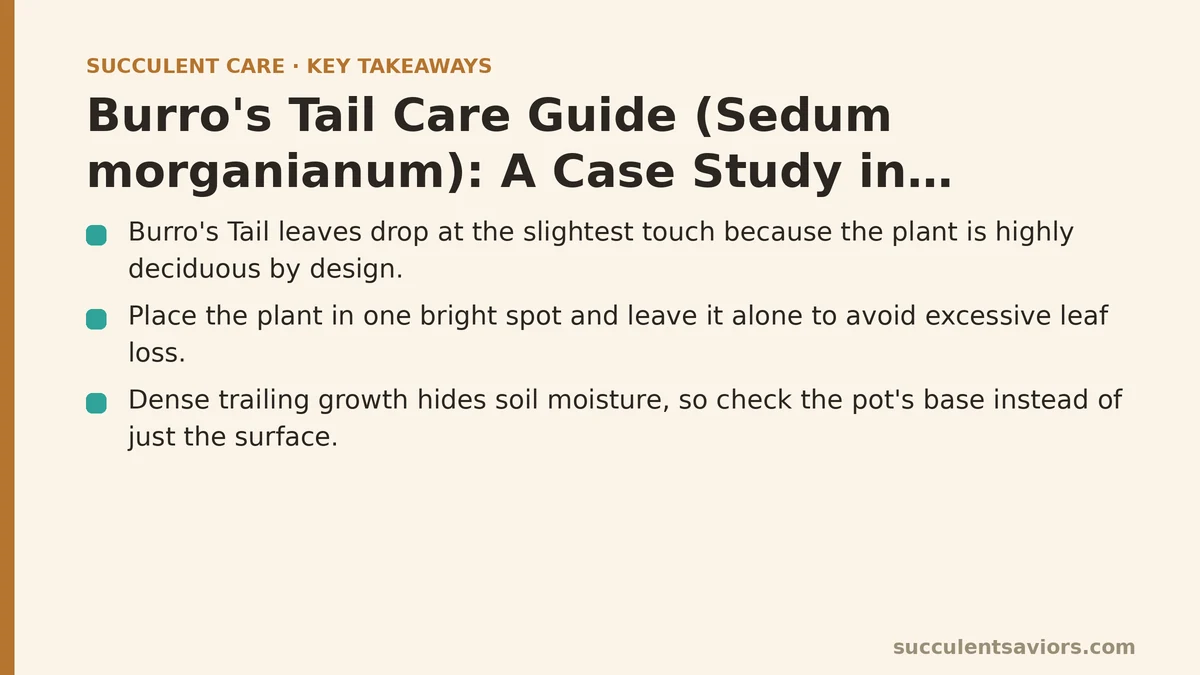
This is the first misunderstanding worth clearing up. Burro’s Tail leaves are attached loosely by design, an adaptation that likely helps the plant propagate itself in the wild when strands brush against soil and break apart. Handling, bumping, or even a strong gust of wind can knock leaves loose. That’s not root rot, pests, or stress in the dramatic sense—it’s just how the plant is built. But it does mean the plant needs to be placed somewhere stable and left alone. Constant relocation, as her plant experienced, causes a level of leaf loss well beyond the normal baseline, and over time that adds up to the thin, see-through strands she brought in.
The fix here wasn’t complicated: pick one bright spot and commit to it. I recommended a spot with several hours of direct morning sun and bright, indirect light the rest of the day—an east-facing window works well, or a south-facing one with a sheer curtain to soften the harshest afternoon rays. Then, don’t move it. Not to “rotate for even growth,” not to “give it a break,” just settle it in and let it acclimate.
Diagnosing the Soil: Why the Base Felt Damp
When I checked the pot itself, the soil near the surface looked dry, but the base felt heavier than it should. This is a common trap with Burro’s Tail because its dense, trailing growth habit hides the soil from view and makes it easy to misjudge moisture levels just by looking. The plastic nursery pot she was using also had only one small drainage hole, which had partially clogged with compacted soil.
Root rot in Burro’s Tail often creeps in slowly rather than announcing itself with obvious mush overnight. Strands near the base may begin thinning first, and unlike the fragile leaf drop from handling, this leaf loss is often accompanied by discoloration—leaves turning a dull yellow-green rather than staying blue-gray—and a soft, less springy feel to the stem itself. We unpotted hers and found the bottom third of the root ball had gone dark and slimy, though the top roots were still firm and white.
We trimmed away the compromised roots, let the plant callus for two days in a dry, shaded spot, and repotted into a terra cotta container with a wide drainage hole and a mix heavy on pumice and coarse sand—at least 60% mineral material, with only a small fraction of organic potting soil. Terra cotta matters more here than with some other succulents, since it wicks away excess moisture and helps compensate for a grower who might water slightly more often than ideal.
Rebuilding Fullness: The Propagation Trick Nobody Mentions Enough
The bare gaps between leaf clusters weren’t going to fill in on their own; established stem sections don’t grow new leaves in the spots where old ones dropped. The strands as they existed would stay exactly as full, or as sparse, as they already were. To get a denser plant, we needed new growth, and new growth in Burro’s Tail comes almost entirely from propagation.
We took the healthiest strand tips, each about four inches long, and let the cut ends dry and callus for about a week—longer than most succulent cuttings need, because Burro’s Tail stems hold more moisture and are prone to rot if planted while still fresh. Once calloused, we laid them across the surface of dry, gritty soil rather than burying them upright. Roots formed along the length of the stem within a few weeks, and new leaf growth began sprouting from the nodes.
This approach also solves a problem growers run into constantly: individual dropped leaves. Nearly any healthy leaf that falls off a Burro’s Tail can be laid on top of soil and will often root and form a tiny new rosette, given bright light and very infrequent misting. It’s slow, and not every leaf takes, but it’s a nearly free way to multiply the plant and eventually fill in a container with dense, cascading growth rather than a few long, sparse strands.
Getting the Watering Rhythm Right
Once repotted, the watering schedule needed resetting too. Burro’s Tail stores water efficiently in both its leaves and stems, which means it tolerates long dry spells far better than frequent watering. A customer’s habit of light watering every few days can keep the soil perpetually damp, exactly the condition that causes rot at the roots.
We switched her to a soak-and-dry approach: water thoroughly until it runs from the drainage hole, then wait until the soil is completely dry at least two inches down before watering again. In her home, with moderate light and normal indoor temperatures, that ended up being roughly every two to three weeks. In winter, it stretched closer to a month. The visual cue to watch for is a slight softening or wrinkling in the leaves nearest the tips of the strands—not a dramatic shrivel, just a subtle loss of firmness that signals it’s time to water again.
Six Months Later: What Changed
By late summer, the difference was dramatic. The original strands, now stable in one bright window and watered on a proper cycle, had thickened and stopped dropping leaves at the rate they once did. The propagated cuttings had filled in around the base of the pot, creating the fuller, layered look she’d wanted from the start. She still lost the occasional leaf when she brushed past the plant reaching for something on the shelf, but she no longer worried about it—she understood it as a normal quirk rather than a failure on her part.
The lesson from her plant applies broadly. Burro’s Tail rewards a hands-off approach far more than most succulents: stable placement, patient watering, gritty soil, and a willingness to propagate rather than expect old growth to fill back in. Fragility isn’t fragility in the usual sense here; it’s just a different kind of resilience, one that shows up through regeneration rather than toughness.
| Issue Observed | Underlying Cause | What Helped |
|---|---|---|
| Frequent leaf drop | Normal deciduous trait, worsened by handling/moving | Choose one stable, bright spot and stop relocating the plant |
| Thinning, dull-colored strands near base | Slow root rot from a clogged pot and frequent light watering | Trim rot, repot in gritty mix, switch to soak-and-dry watering |
| Sparse gaps between leaves | Old stem sections won’t regrow lost leaves | Propagate stem cuttings and individual leaves to fill in fullness |
| Slight softening at strand tips | Early sign of thirst, not disaster | Water thoroughly, then wait for full dryness before the next round |
If your Burro’s Tail is shedding leaves right now, take a moment before assuming the worst—ask yourself whether it’s been handled or moved recently, or whether the base of the pot might be holding more water than the surface lets on.
Related guides: String of Pearls Care Guide (Senecio rowleyanus): A Troubleshooting Approach, Aeonium Care Guide: Troubleshooting Common Problems, and Agave Care Guide: Types and Care Tips for a Thriving Collection.