By the end of this post, you’ll be able to look at any struggling Echeveria and name the specific mistake causing the problem, then apply the fix that matches—whether it’s light, water, soil, or timing. To do that, we’re going to follow one plant from a sad, stretched rosette back to something dense and colorful, since that’s how most of us learn these things.
Consider a plant referred to here as the Blue Ruffles. It came to me in late spring, tucked into a ceramic pot with no drainage hole. The owner had done everything a beginner does: watered it on a schedule, kept it near a window, and loved it. Six months later, it was nearly twice as tall as it was wide, pale green in the center, brown and shriveled on the bottom leaves, and the crown was tight enough to pinch.
Here’s what went wrong, in order of how obvious the damage was.
Mistake 1: Watering to a Calendar Instead of the Soil
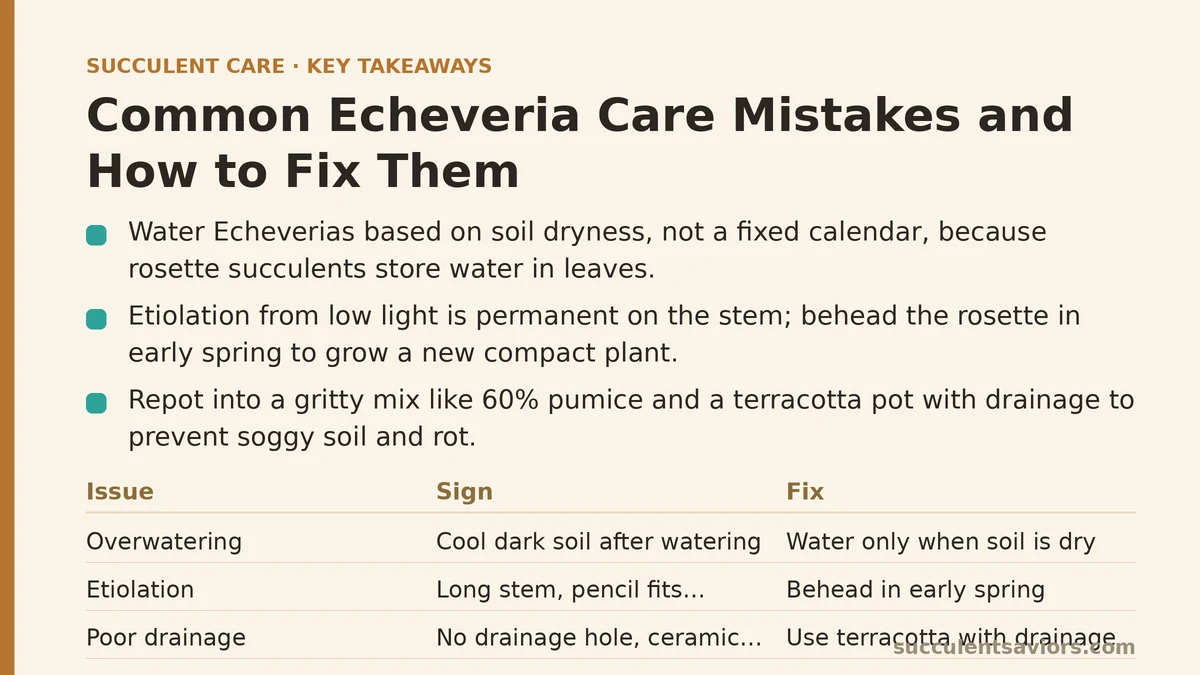
The Blue Ruffles’ owner watered every Sunday. That’s the most common habit I see, and it’s the one that does the most damage with Echeverias, because rosette succulents store water in their leaves and need to dry out completely between drinks. Sunday watering in June is survivable. Sunday watering in January, in a cool room, in a pot with no drainage—that’s a slow drowning.
What to look for instead: Push a wooden chopstick or your finger two inches into the soil. If it comes out cool and dark, wait. If it comes out dry with a faint dusty smell, water. The soil surface lies; it can be bone-dry crust over soggy pockets underneath, especially with peat-based mixes.
Two realistic options if you’re transitioning off a schedule:
- A moisture meter (cheap, helpful for the first few months, unreliable once the probe corrodes—replace it yearly)
- The lift test: pick up the pot. Dry pots feel startlingly light. Once you’ve felt a dry Echeveria pot once, you’ll know it forever.
That October, I moved the Blue Ruffles to a gritty mix with about 60% pumice and re-potted it into a terracotta pot with a drainage hole. Terracotta wicks moisture out of the soil through the walls. It’s the single best pot choice for an Echeveria in a humid climate or a cool room.
Mistake 2: Confusing Stretch With Growth
The Blue Ruffles had grown. That’s what its owner loved about it. She’d point to the lengthening stem and say “look how much it’s grown.” It had, but it was growing toward something—the window—not growing well. This is etiolation, and it can’t be reversed by turning the plant around. The stretched stem is permanent. The fix is to grow a new rosette on top.
How to tell stretch from healthy growth: A healthy Echeveria grows in a tight spiral. New leaves in the center of the rosette should be smaller than the outer ones and packed so densely that you can barely see the stem between them. If you can slide a pencil between two leaves, the plant is reaching for light. The color is a clue too: Echeverias develop their best blues, pinks, and purples under bright light and cool nighttime temperatures. A pale, uniform green with a long stem is a plant saying “I’m not getting enough sun.”
The fix, in practice:
- Wait until early spring, when the plant is entering its growing season.
- Use a clean, sharp blade to cut about an inch below the rosette. You’ll have a beheaded top.
- Let the cut end callus over for three or four days somewhere out of direct sun—it should feel dry and leathery, not soft.
- Plant the rosette into dry gritty soil, and don’t water for a week.
- Keep the old stem. With enough light, it will push out two or three new rosettes from the remaining leaf nodes. This is how one stretched plant becomes three.
If you can’t give the Echeveria six hours of bright, indirect light—or a spot near a south- or west-facing window—do the grow light math instead. A small clip-on LED in the 6500K range, kept about eight inches above the plant for 12-14 hours a day, will keep the rosette tight.
Mistake 3: Assuming All Echeverias Want the Same Water and Light
This is where things get interesting, because the Blue Ruffles wasn’t just one plant. It was three different rosettes in one pot—an Echeveria elegans, an Echeveria pulidonis, and a hybrid the owner had picked up at a hardware store and never identified. They were all in the same soil.
Echeveria elegans wants bright light and can handle slight neglect. Echeveria pulidonis wants more sun and goes a rich red at the leaf edges under cool temperatures. The hybrid was somewhere between them. Grouping them together meant one plant was always going to lose.
If you keep a mixed planter, watch for the rosette that looks different first. It’s telling you the group’s conditions don’t quite fit it. I separated the Blue Ruffles into three pots that spring, gave the pulidonis the sunniest corner of the bench, moved the elegans slightly back, and the hybrid went up on a shelf under the LED strip.
If you’re choosing between one big showpiece or a collection of small singles, know that the showpiece is easier for a beginner. One plant, one set of needs, one pot to read. A mixed planter is more rewarding but harder—it’s the difference between learning to drive a sedan and learning to drive a truck.
Mistake 4: Ignoring What the Leaves Tell You About Pests and Rot
The Blue Ruffles’ bottom leaves were shriveled and brown, and its owner assumed that meant “underwatered.” It did not. It meant the roots were gone. Rotting roots can’t pull water up to the leaves, so the plant shows the same shriveled signal as a thirsty plant—but the fix is the opposite. This is where beginners lose the most plants, because they water more to help, and the plant dies faster.
The smell test, which you’ll use more than you expect: Unpot the plant and smell the root ball. Healthy Echeveria roots are white, firm, and smell faintly of clean soil. Rotting roots are dark, slick, and smell sour or like a wet basement. That smell is your answer. There’s no gray area once you’ve experienced it once.
The fix for rot: Cut away every dark, soft root with sterilized scissors until you see clean white tissue, let the plant dry in the open air for two or three days, then repot in fresh dry gritty mix and don’t water for a week. If the crown of the plant itself has gone soft and translucent, the rot has already moved up—behead the top couple of inches of the rosette and root that instead.
The pest side of the same inspection: Every time you repot, look for mealybugs (small white cottony clusters tucked into leaf axils) and check the underside of the outer leaves for the faint stippling of spider mites. Both love the soft, crowded leaves of an Echeveria. A cotton swab dipped in 70% isopropyl alcohol knocks out small mealybug populations on contact, but you’ll want to repeat the treatment every few days for three or four weeks, because eggs survive the first pass.
What the Blue Ruffles Looked Like in June
Three pots, all in terracotta, all in gritty mix. The pulidonis had gone red at the tips from cool spring nights on the sunniest shelf. The elegans was compact, its leaves like blue-gray spoons stacked in a tight rosette. The hybrid, the one I hadn’t identified, turned out to have a soft pink edge that only appeared under the LED strip—it had been growing green in its old spot for a year and I hadn’t known what color it was.
Watering happened when the chopstick came out dry and the pot felt light—sometimes every 10 days in summer, sometimes every three weeks in winter. No more Sundays.
The original owner came by to pick up her plants. She lifted the pulidonis pot and said, “It feels lighter than I expected.” That’s the moment it clicked for her. Every fix in this post starts with paying attention to what the plant is doing now, not what the last blog post said you should do on a schedule.
If you’ve got a stretched Echeveria on a windowsill right now, tell me its color and how far apart the leaf pairs are—that’s usually enough for me to guess whether it needs more light or less water.
Related guides: Echeveria Care Guide: Growing Colorful Rosettes (Beginner vs. Advanced), Aeonium Care Guide: Troubleshooting Common Problems, and Succulent Watering Mistakes: A Troubleshooting Chart for Common Problems.