Pest control failure on succulents is rarely a product problem. It is, in almost every case, a strategy problem. Mealybugs and spider mites are two of the most common indoor succulent pests, yet they are routinely misdiagnosed, mistreated, or treated halfway—and then the infestation returns worse than before. The gap between a successful treatment and a frustrating relapse usually comes down to five specific misunderstandings about how these pests live, feed, and reproduce.
This post breaks down the five most common pest-treatment myths, what the reality is, and the practical fix that stops the cycle for good.
Myth #1: Alcohol Kills Mealybugs Instantly, So Once Is Enough
Rubbing alcohol is a standard first-line treatment for mealybugs, and it does kill the adults on contact. The myth creeps in when growers see the white fuzzy bodies dissolve, declare victory, and put the plant back on the shelf. Three weeks later, the cottony clusters are back, thicker than before.
The reality: Alcohol only kills the insects it physically touches. Mealybug eggs are protected inside a waxy egg sac that alcohol cannot penetrate, and nymphs hide in the tight crevices where leaf meets stem—spots a spray or cotton swab rarely reaches. A single application removes the visible problem while the invisible next generation matures undisturbed.
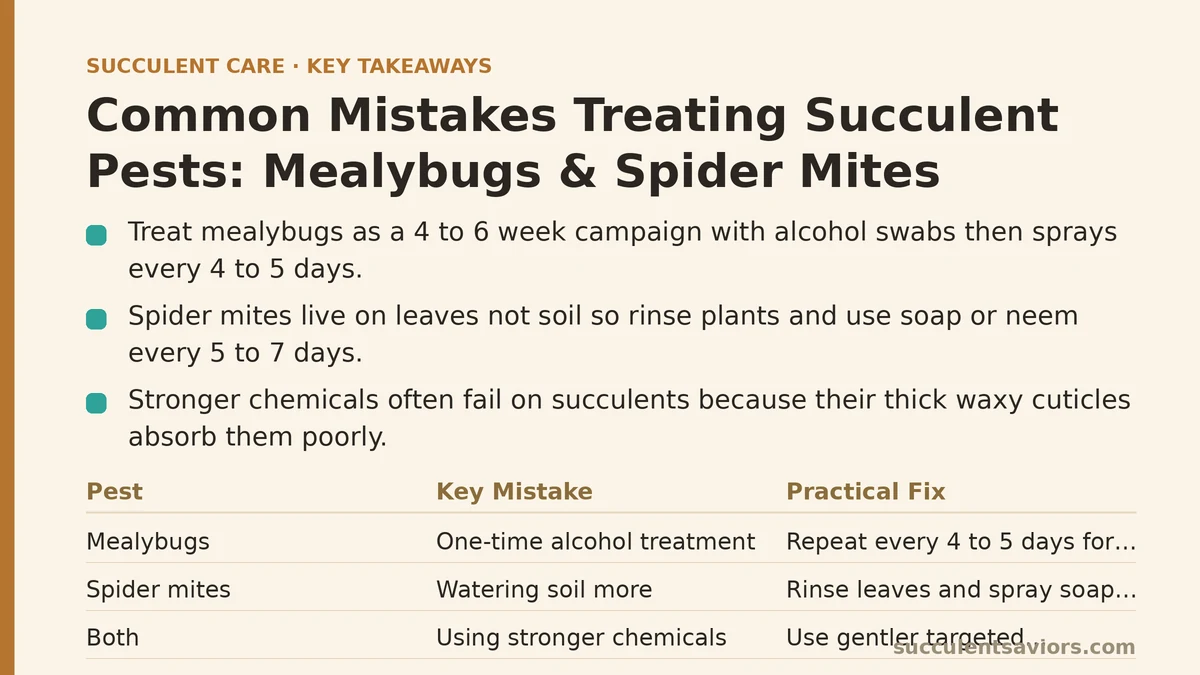
The fix: Treat every infestation as a 4-to-6 week campaign, not a one-time event. Apply 70% isopropyl alcohol with a cotton swab directly to visible mealybugs, then follow up every 4 to 5 days with a thorough plant-wide spray. Each pass catches newly hatched nymphs before they mature and lay more eggs. Consistency matters more than intensity. Miss one round, and you reset the clock.
Myth #2: Spider Mites Are a Dry-Plant Problem, So Just Water More
Spider mites do thrive in hot, dry conditions, and underwatered succulents do become more vulnerable. That correlation leads many growers to respond by increasing humidity or watering frequency. The plant perks up, the webbing seems to fade—and then the mites return the moment conditions dry out again.
The reality: Mites live on the leaf surface, not in the soil. Watering the roots does nothing to remove a mite population already established on the plant. The fine stippling damage and pale, dusty appearance on the leaves is caused by mites piercing individual plant cells and draining their contents. A hydrated plant tolerates the damage better, but it does not repel the mites.
The fix: Address both the environment and the infestation directly. Rinse the plant thoroughly with a strong spray of water to knock off adult mites and disrupt their webbing, paying special attention to leaf undersides. Then apply an insecticidal soap or neem oil solution to every surface, repeating every 5 to 7 days for three consecutive treatments. In parallel, raise humidity around the plant with a pebble tray or humidifier—mites dislike moist air—rather than watering the soil more.
Myth #3: Stronger Chemicals Always Work Better Than Gentler Options
When a mild treatment fails, the instinct is to reach for a broad-spectrum insecticide. The thinking goes: if the soap did not work, the heavy artillery will. This approach frequently backfires in two measurable ways.
The reality: Succulents have thick, waxy cuticles designed to retain water. Many systemic and contact insecticides are formulated for thin-leaved plants and absorb poorly through succulent tissue, leaving the chemical sitting on the surface where it does little. Worse, harsh chemicals can burn delicate leaf coatings, causing scarring or leaf drop that looks like pest damage and sends you chasing the wrong problem.
The fix: Match the chemistry to the pest and the plant. For mealybugs, systemic options containing imidacloprid are absorbed through the roots and work well—but only if applied as a soil drench, not a foliar spray. For spider mites, insecticidal soap or horticultural oil physically smothers the mites and is safe on succulents when applied in cooler evening hours to avoid sunburn. If you need something stronger, rotate between two different active ingredients every few weeks to prevent resistance, and always test on a single leaf first before treating the whole plant.
Myth #4: You Can Spot-Treat an Infestation Without Quarantining the Plant
You find one mealybug on a single succulent, treat that plant, and leave it sitting next to your healthy collection. The assumption is that spot treatment handled the problem—until you notice the same white fluff on three other pots a week later.
The reality: Both mealybugs and spider mites are mobile and spread quickly. Mealybug crawlers are tiny and can walk between pots that are touching. Spider mites spin silk strands that catch air currents, allowing them to drift several feet onto neighboring plants. A single untreated plant can seed an entire collection within two to three weeks.
The fix: The moment you spot either pest, physically isolate the affected plant in a separate room or at least several feet away from all others. Treat the quarantined plant as the only actively infested one for a full month, and inspect every other succulent weekly during that period. Inspect the undersides of leaves and the soil surface—the two places both pests prefer to hide first. Reintegration happens only after you have gone two consecutive weeks with no new signs.
Myth #5: If You Cannot See the Pests Anymore, the Problem Is Solved
This is the most expensive mistake of all. Visible mealybugs disappear after treatment, leaf stippling fades, and the plant looks healthy again. You stop inspecting, stop treating, and stop worrying. Six weeks later, a sudden explosion of pests forces you to start over from scratch.
The reality: Mealbug eggs can survive dormant for several weeks inside leaf axils. Spider mite eggs also persist on leaf surfaces and in webbing remnants. Both can hatch after the active adults are gone, and the new generation is often larger because the survivors have had time to build resistance. The absence of visible pests is not proof of eradication—it is only evidence that the current generation has been suppressed.
The fix: Build a two-part post-treatment protocol. First, continue preventive sprays every 10 to 14 days for six weeks after the last visible pest disappears. Second, make weekly inspection a permanent habit. Check the undersides of leaves, the crown of the plant, and the soil surface with a magnifying glass or a phone camera zoom. Look for the subtle early signs: fine webbing, tiny white flecks, or the faint stippled pattern that indicates mite feeding. Catching a new outbreak at two individuals is a ten-minute fix; catching it at two hundred is a full-scale operation.
Quick Reference: Myths Versus Reality
| Common Myth | What Happens | The Reliable Fix |
|---|---|---|
| One alcohol treatment kills mealybugs | Eggs and nymphs survive to reinfest | 4–6 weeks of repeat treatments every 4–5 days |
| Watering more fixes spider mites | Roots do not affect leaf-surface mites | Rinse, spray with soap, and raise humidity |
| Stronger chemicals work better | Succulents absorb them poorly; leaves burn | Use systemic drench for mealybugs, soap for mites |
| Spot-treating is enough | Pests migrate to nearby plants fast | Quarantine for a full month, inspect weekly |
| No visible pests = solved | Eggs hatch and resistance builds | Continue sprays 6 weeks; inspect weekly permanently |
The common thread across all five myths is the same: pest treatment fails when it is treated as a one-time action instead of a sustained process. Each pest has a lifecycle, and your job is to interrupt that lifecycle at every stage—egg, nymph, and adult—long enough to break the reproduction cycle. The succulents that survive pest outbreaks are not the ones treated with the strongest chemicals. They are the ones whose growers inspected weekly, treated consistently, and refused to declare victory until six quiet weeks had passed.
Which of these mistakes have you caught yourself making—skipping the repeat treatments, or skipping the quarantine because you were short on shelf space?
Related guides: How to Treat Mealybugs on Succulents Naturally, Succulent Pest Treatment with Neem Oil: A Step-by-Step Beginner Guide, and Common Mistakes When Using Neem Oil on Succulents (And How to Avoid Them).