After you finish this guide, you’ll be able to walk through your indoor succulent setup in late fall and identify—and correct—every mistake that commonly sends plants to the compost bin before spring. You’ll know what to look for, why it happens, and the exact fix, without guessing.
The shift from outdoor summer growth to indoor winter survival is where most collections lose plants. Not because the plants are fragile, but because the environment changes so dramatically and the signals of trouble are quiet. Here are the seven mistakes that kill more indoor succulents over winter than anything else, presented as a checklist: symptom first, then cause, then fix.
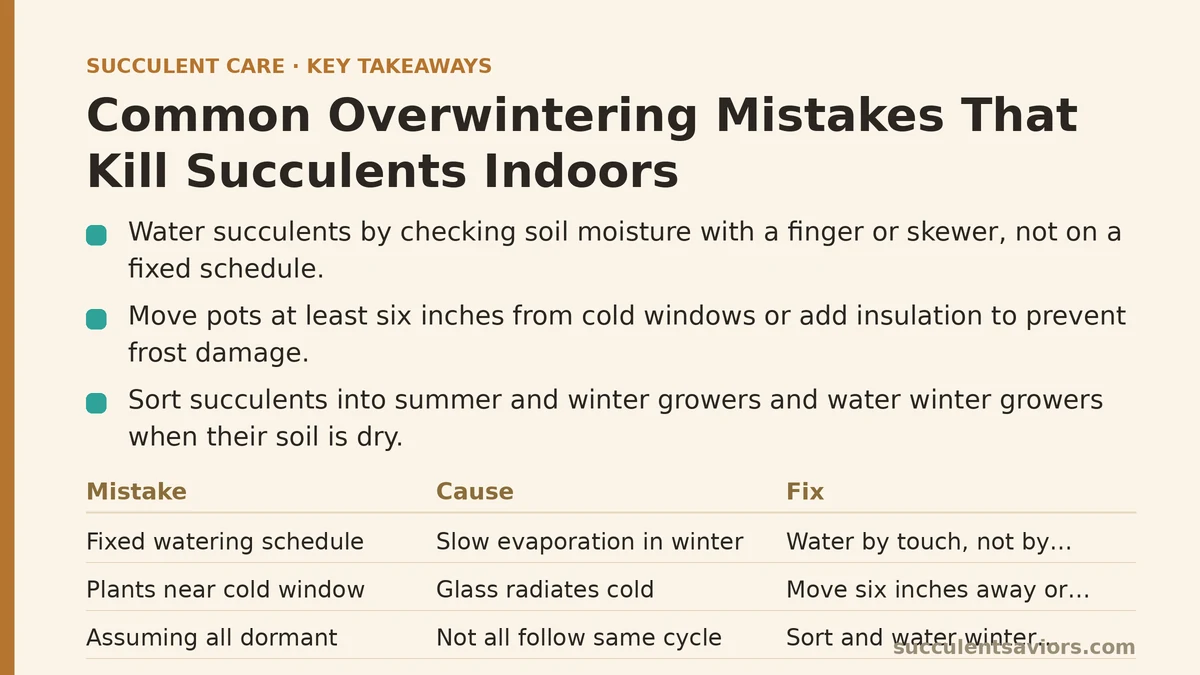
Mistake #1: Watering on a Fixed Schedule
Symptom: You water every Sunday, same as you did in July. By February, the lower leaves on your Echeveria are translucent, the stem feels soft near the soil, and the pot smells faintly sour.
Cause: Indoor winter conditions—shorter days, lower light, cooler windowsill temperatures—slow evaporation dramatically. A pot that dried out in four days during summer might take three weeks in January. A fixed schedule delivers water to soil that’s still damp from the previous session, and the roots suffocate. Root rot doesn’t announce itself until the damage is done.
Fix: Water by touch, not by calendar. Push a wooden skewer or your finger two inches into the soil. If it comes out dry and clean, water thoroughly. If there’s any resistance from moisture, wait another week and check again. In practice, this often means watering once every two to four weeks, but the interval varies by pot size, soil mix, and room temperature. Your finger is more reliable than any rule.
Mistake #2: Leaving Plants Next to a Cold Window
Symptom: Leaves near the glass are mushy and water-stained, while leaves on the room side look perfectly healthy. The damage appears overnight after a frosty night, and it doesn’t spread.
Cause: Glass radiates cold. Even in a heated room, the air right next to a window can drop below freezing on a bitter night, and the soil in the pot cools to match. Succulent cell walls rupture when they freeze, turning leaves to translucent jelly. This is not root rot—it’s frost damage, and it’s localized to whatever touched the cold glass.
Fix: Move pots at least six inches away from windows during the coldest months, or place a layer of cardboard or bubble wrap between the pot and the glass. If you have a particularly cold windowsill, set a small thermometer there for a week and check morning temperatures. If it reads below 45°F (7°C), your plants need to move. A simple shelf a foot back from the window keeps them bright without the frost risk.
Mistake #3: Assuming Every Succulent Is Dormant
Symptom: Your Haworthia and Aloe are putting out fresh green growth in December, but you’ve been treating them like their dormant Echeveria neighbors—no water for six weeks. The new leaves are thin, wrinkled, and the tips are browning.
Cause: Not all succulents follow the same seasonal cycle. While Echeveria, Sedum, and most Crassula slow down in winter, winter growers like Haworthia, Aloe, and Aeonium are in their active growing season. They need occasional water and brighter light. The “water less in winter” rule applies unevenly, and applying it uniformly starves the winter growers.
Fix: Sort your collection before the cold arrives. Label two groups: summer growers and winter growers. Water the winter growers when their soil is dry—often every ten to fourteen days—and give them the brightest spot you have. Check them weekly for signs of new growth; active growth is your cue that they’re thirsty more often than their dormant neighbors.
Mistake #4: Letting Grow Lights Run Too Close or Too Long
Symptom: The tops of your succulents are fading to a pale, bleached green, and the leaf tips nearest the light are turning brown and crispy. Some leaves have a sunburned, papery patch on the side facing the lamp.
Cause: Grow lights are powerful tools, but they’re easy to overuse. A light positioned six inches above a plant, running 14 hours a day, can burn leaves the same way intense afternoon sun does. The plant heats up, the chlorophyll breaks down, and the tissue dries out. This is a winter-specific mistake because people buy lights to compensate for short days and then leave them on too long, too close.
Fix: Position full-spectrum LED grow lights 12 to 18 inches above your plants, not six. Run them on a timer for 10 to 12 hours a day, matching natural daylight hours—not 16, not all day. Watch your plants for two weeks after setup. If the color deepens and growth stays compact, the light level is right. If you see bleaching or crisping, raise the light or shorten the duration. If you see stretching, lower it slightly or extend the time. Adjust in small increments.
Mistake #5: Forgetting That Heating Vents Dry Everything Unevenly
Symptom: The leaves on the side of the plant facing your heating vent are shriveled and wrinkled, while the opposite side looks plump. The soil dries out in patches—one side bone dry, the other side still damp a week after watering.
Cause: Forced-air heating blows hot, dry air directly onto one side of the plant. This pulls moisture out of the leaves and soil faster than the roots can replace it, creating a lopsided dehydration. The plant is simultaneously underwatered on one side and normally watered on the other, and it can’t compensate.
Fix: Move plants away from direct heating vent airflow—at least three feet, or behind a shelf that blocks the blast. If you can’t move them, place a tall glass or a tray of pebbles and water between the vent and the plant to diffuse the airflow and add humidity to the immediate area. Check soil moisture on all sides of the pot, not just the side facing you, and water when the driest side is dry.
Mistake #6: Repotting at the Wrong Time
Symptom: You repotted a struggling succulent in December, gave it a good watering, and within two weeks it went limp. The roots never recovered, and the plant slowly declined through February.
Cause: Repotting is a shock to the root system, and dormant plants don’t have the metabolic energy to regrow damaged roots quickly. When you repot in winter, the roots sit in fresh, moist soil for weeks without growing, and the risk of rot spikes. The plant can’t recover because it’s not actively growing.
Fix: If you must repot in winter, do it as a rescue intervention—for root rot or pest infestations—and keep the plant in dry soil for at least ten days afterward, in a spot with brighter than average light. For routine repotting, wait until late spring, when active growth has resumed. In winter, surface-dress instead: scrape off the top inch of old soil and replace it with fresh gritty mix. This refreshes nutrients without touching the roots.
Mistake #7: Ignoring Pests That Explode Indoors
Symptom: You notice fine webbing on the undersides of leaves, or tiny white cottony specks in the leaf axils. A week later, the plant looks dusty and sickly, and the pests have spread to three neighboring pots.
Cause: Indoor winter conditions—warmer, drier, and more crowded than outdoors—are ideal for spider mites and mealybugs to reproduce rapidly. Plants that came inside in fall may have carried hidden eggs, and indoors there are no predators to keep them in check. A small infestation becomes a colony in weeks.
Fix: Inspect every plant the moment you bring it indoors, and quarantine any suspicious specimen for two weeks. Check weekly through winter: look at the undersides of leaves, the junctions where leaves meet stems, and the soil surface for fine webbing or cottony masses. At the first sign, isolate the plant and treat with a cotton swab dipped in rubbing alcohol for mealybugs, or a neem oil spray for mites. Repeat the treatment every five days for three cycles. Prevention—checking every plant on arrival—is far easier than treating a colony that’s already spread across your shelf.
Quick Reference: Seven Mistakes at a Glance
| Mistake | Key Symptom | Immediate Fix |
|---|---|---|
| Fixed watering schedule | Translucent lower leaves, sour pots | Water only when soil is dry to two inches deep |
| Cold window exposure | Mushy leaves near glass, healthy on room side | Move pots 6+ inches from glass, use thermometer |
| Treating all succulents the same | Winter growers shriveled while dormant plants fine | Sort into summer/winter grower groups, water accordingly |
| Grow lights too close or too long | Bleached tops, crispy leaf tips | Raise light to 12–18 inches, run 10–12 hrs on timer |
| Heating vent airflow | Wrinkled leaves on one side only | Move plant or block airflow with tray/dispersion barrier |
| Repotting during dormancy | Declining plant, roots never recover | Surface-dress instead; repot only as rescue, keep dry afterward |
| Ignoring indoor pests | Webbing, cottony specks, spreading damage | Inspect on arrival, quarantine, treat every 5 days |
Winter indoors is a different habitat for a succulent than summer outdoors, and the mistakes that kill plants are almost always about failing to adjust to that shift. The good news: every one of these is preventable by checking soil moisture, watching leaf color, and inspecting plants regularly.
Which of these seven mistakes have you caught yourself making in past winters—was it the fixed watering schedule, or the surprised discovery of spider mites in February?
Related guides: Why Succulent Leaves Turn Mushy: Common Mistakes and Fixes, Aeonium Care Guide: Troubleshooting Common Problems, and Step-by-Step Guide to Repotting Succulents Without Shock.