By the end of this guide, you will be able to diagnose exactly why your String of Buttons is stretching, turning pale, or dropping lower leaves—and you will know the precise conditions it needs to grow into a dense, stacked, sun-kissed column. We are going to separate the myths from the measurable realities of Crassula perforata care.
String of Buttons is a structural marvel. Its leaves wrap around the stem in perfect, cross-shaped pairs, like beads threaded on a vertical string. It is hardy, forgiving, and fast-growing under the right conditions. Yet it is also the victim of more generic succulent advice than almost any other plant I encounter in my practice. The myths around it are widespread. Let us dismantle them, one by one.
Myth #1: String of Buttons Is a Low-Light Plant Because It Grows Indoors
The Reality: This is the most damaging myth in the entire succulent world, and Crassula perforata suffers from it constantly. It is a popular office plant because it tolerates neglect, and people mistake tolerance for preference.
In its native South Africa, String of Buttons grows in full, direct sun on rocky slopes. Indoors, it needs the brightest window you own—south-facing or west-facing—with several hours of direct sunlight hitting the foliage. Anything less, and the plant will etiolate within weeks.
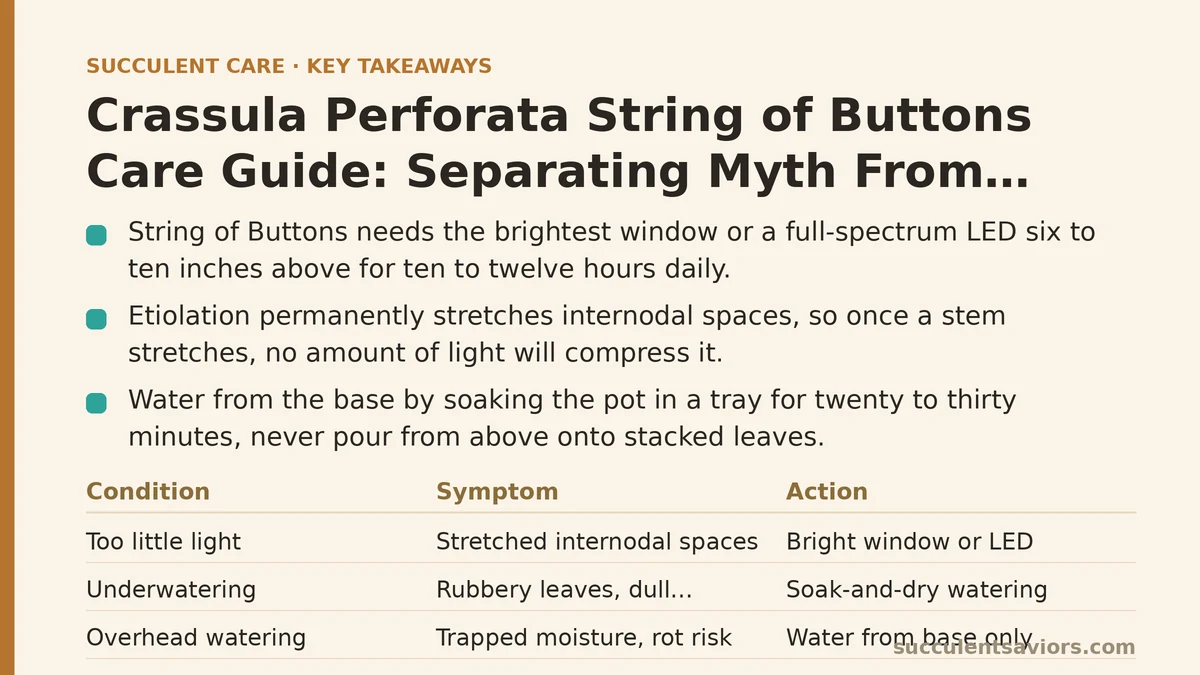
What etiolation looks like on this particular species is distinctive: the internodal spaces—the gaps between each leaf pair—stretch out, turning a dense column into a loose, open spiral. The plant stops looking like a stack of buttons and starts looking like a vine with widely spaced leaves. This stretching is permanent; no amount of light afterward will compress the already-stretched stem.
If you do not have a bright window, you need a grow light. A full-spectrum LED panel placed six to ten inches above the plant, running ten to twelve hours daily, will keep the growth compact. In general, this single intervention fixes more etiolated String of Buttons than any other change.
Myth #2: This Succulent Thrives on “Neglect” and Barely Needs Water
The Reality: There is a grain of truth here, but it has been twisted into dangerous advice. String of Buttons is drought-tolerant, yes. It can survive long dry periods. But “survive” is not “thrive.” A consistently dehydrated plant will show its stress in clear ways: leaves that feel rubbery rather than firm, a dull gray-green cast instead of bright green, and premature leaf drop from the bottom of the stems.
The accurate watering protocol is the same soak-and-dry rhythm that works for most Crassulas, with one critical adjustment for this species. Because the leaves are tightly packed along the stem, water can become trapped between the leaf pairs, especially in humid conditions. That trapped moisture invites rot at the leaf axils, which spreads down the stem faster than root rot in many cases.
So, the reality is this: water thoroughly, but water from the base. Place the pot in a tray of water for twenty to thirty minutes, allowing the soil to wick moisture upward. Never pour water from above directly onto the stacked foliage. After watering, ensure excellent airflow around the plant so any residual surface moisture evaporates quickly.
In between waterings, the soil must go completely bone-dry. I check with a wooden skewer pushed to the bottom of the pot. If the skewer comes out with any soil stuck to it, I wait. In summer, depending on your pot size and light, this might be every seven to ten days. In winter, it could stretch to every three to four weeks. There is no calendar rule. There is only the moisture check.
Myth #3: Regular Potting Soil Is Fine If You Let It Dry Out
The Reality: This is the myth that kills more String of Buttons than any other single mistake. Standard houseplant potting mix holds far too much moisture for a succulent that evolved in rocky, fast-draining soil. Even if you adhere to a strict watering schedule, the soil stays damp long enough for the fine root hairs to suffocate and begin to decay.
The fix is a gritty, mineral-heavy mix. A recipe that is consistently recommended is one part coarse pumice, one part perlite, and one part quality succulent soil. If pumice is hard to find, coarse aquarium gravel or crushed granite works well. The goal is a mix that feels almost sandy when dry, holds its structure when wet, and drains completely within a minute or two after watering.
In practice, a well-draining mix changes your entire relationship with this plant. You can breathe easier when you water, because overwatering becomes almost impossible. The roots stay aerated, and the plant pushes new growth with visible vigor instead of merely surviving.
Myth #4: String of Buttons Does Not Need Fertilizer Because It Is a Succulent
The Reality: Succulents do not need much fertilizer, but they do need some. A plant growing in a purely mineral mix—which is ideal for drainage—has almost no nutrient reservoir. Without any supplementation, growth will slow to a crawl, and the bottom leaves will yellow and drop faster than they should, even in the growing season.
The reality is a targeted feeding schedule. From early spring through late summer, feed once a month with a balanced liquid fertilizer diluted to half strength. I favor a formula with an N-P-K ratio around 4-4-4 or 5-10-10. The lower nitrogen ratio is preferable because too much nitrogen pushes soft, rapid growth that is prone to rot. A tomato fertilizer, diluted to a quarter strength, also works well.
In autumn and winter, when the plant’s metabolism slows, stop feeding entirely. The plant does not need the nutrients, and fertilizing a dormant plant can damage the roots.
Myth #5: The Best Way to Propagate String of Buttons Is by Leaf Cuttings
The Reality: Leaf cuttings are the go-to method for many succulents like Echeveria or Graptopetalum. They are efficient and reliable. But for Crassula perforata, leaf cuttings are the slowest, least reliable path to a new plant. The leaves are small, and each one takes many months to produce even a tiny root system.
The reliable method is a stem cutting. In spring, take a four-to-six-inch stem tip from a healthy plant. Remove the lowest pair or two of leaves, exposing a short section of bare stem. Let the cut end callus over for three to five days in a dry, shaded spot. Then, plant the cutting directly into a gritty soil mix and wait.
Here is the key reality about rooting: do not water the cutting for at least a week after planting. The callused stem needs to begin forming roots in response to moisture in the soil, but standing water will rot the cut end before roots form. Wait a week, then water lightly. Within three to four weeks, you should see new growth at the tip of the cutting, which confirms root establishment.
Multiple stem cuttings placed together in one pot will produce a much fuller, denser plant much faster than a single cutting. This is the method professionals use, and it is measurably faster than the leaf-cutting route.
Myth #6: Red-Edged Leaves Mean the Plant Is Stressed and Dying
The Reality: Many growers see the beautiful red, orange, or purple flushing along the margins of the leaves and panic, assuming something is wrong. The opposite is true. That coloration is a sign of a happy, sun-stressed plant.
When String of Buttons receives sufficient direct light, it produces anthocyanin pigments—the same compounds that color autumn leaves—to protect its tissues from excess radiation. This stress coloring is a completely healthy response. It deepens the visual appeal of the plant and indicates that it is getting the light it needs to grow compact and strong.
What should concern you is a plant that has turned pale green or washed-out yellow. That indicates too much heat, or possibly a nutrient imbalance, and usually accompanies soft, limp leaves. If the leaves are firm, the stem is upright, and the edges are turning rosy, your plant is in excellent condition. Do not change a thing.
Myth vs. Reality Quick Reference
| Issue | Myth | Reality |
|---|---|---|
| Light needs | Low light is fine | Needs bright, direct sun or strong grow light |
| Watering | Water monthly, ignore it | Soak-and-dry based on soil check; water from below |
| Soil | Regular potting mix works | Needs gritty mineral mix with high drainage |
| Fertilizer | Never fertilize succulents | Feed monthly in growing season at half strength |
| Propagation | Leaves are best | Stem cuttings callused and rooted in gritty mix |
| Leaf coloration | Red edges = dying | Red edges = healthy sun stress response |
| Stretched stems | It will fix itself with time | Stretching is permanent; needs more light now |
The myths around String of Buttons are consistent and pervasive. They come from treating all succulents as a single category, ignoring the specific ecology of each species. Crassula perforata is not a demanding plant by any measure, but it does require conditions that mimic its native rocky slopes: intense light, sharp drainage, dry periods between deep waterings, and a modest feeding schedule.
The most common failure I see—a plant that is alive but never thriving, with open, leggy internodes and a washed-out complexion—is almost always caused by the first myth alone. That single source of confusion, rooted in the assumption that a succulent can live happily on a shelf across the room from a window, cascades into every other problem.
Measure your light before you measure your water. Look at the redness in the leaf edges as a report card. Feel the soil with your fingers rather than consulting a calendar. When you respond to conditions instead of assumptions, your String of Buttons stops being a plant you are keeping alive and becomes a plant that visibly, measurably thrives.
Which myth has kept your String of Buttons from reaching its full potential—the low-light assumption, or the overwatering that follows from a mix that holds moisture too long?
Related guides: Jade Plant Care Guide (Crassula ovata): The 5 Care Factors Ranked by Importance, String of Hearts Care Guide (Ceropegia woodii): A Step-by-Step Walkthrough, and String of Pearls Care Guide (Senecio rowleyanus): A Troubleshooting Approach.