Say you are trying to figure out why the Echeveria on your windowsill has never once sent up a bloom stalk, even though the one at your local nursery flowers every spring like clockwork. You’ve had the plant for two years. You water it, you rotate it, you even talk to it occasionally. Still, nothing. Meanwhile your neighbor’s neglected jade plant, sitting in a dusty corner, threw out a cluster of tiny star-shaped flowers last winter without any help at all. It doesn’t seem fair, and it isn’t intuitive—but it is explainable.
Succulents absolutely flower. Nearly every species is capable of it. The gap between “capable of” and “actually does” comes down to a short list of conditions, and most plants are missing at least one of them. Below is that list, ranked by how often each factor is the real culprit, based on the pattern I see over and over in customer plants brought into the shop.
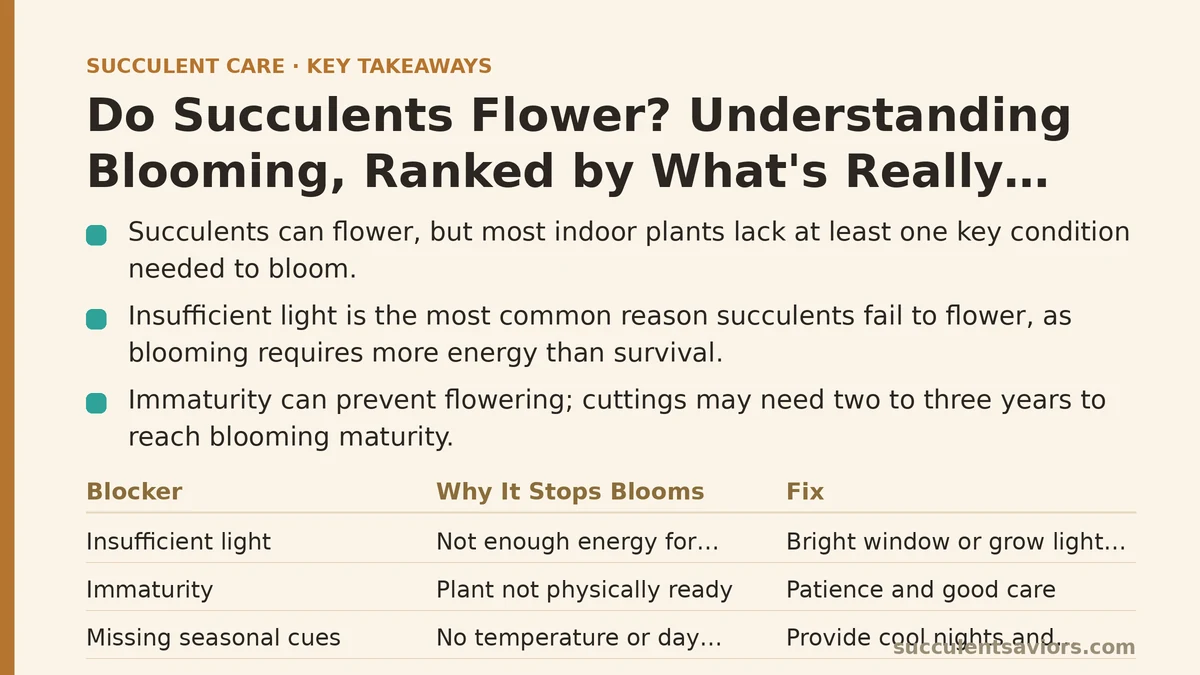
1. Insufficient Light (The Most Common Blocker, By Far)
If I had to bet on a single reason your succulent has never bloomed, this is where I’d put my money. Flowering is expensive for a plant. It requires energy reserves that a succulent simply won’t spend unless it’s getting more light than the bare minimum needed to survive.
A plant kept in a dim corner or a few feet back from a window may hold on to its color and even put out new leaves, but it will treat blooming as a luxury it can’t afford. There’s a real difference between “enough light to live” and “enough light to flower,” and most indoor succulents only get the former.
The fix: Move the plant to your brightest window, ideally one with several hours of direct or very strong indirect sun, and consider that many flowering succulents—Echeveria and Kalanchoe especially—do best with some direct morning or evening sun rather than filtered light all day. If a windowsill can’t deliver that, a dedicated grow light run for 10-12 hours daily can supply what natural light is missing. Give it a full growing season under improved light before you judge whether it worked.
2. Immaturity (An Underrated Reason Growers Overlook)
Here’s something that surprises a lot of people: a succulent needs to reach a certain size and age before it’s physically capable of flowering, regardless of how perfect its care is. This is especially true for plants grown from leaf or stem cuttings, which start life small and take time to build up the energy reserves needed for reproduction.
An Echeveria propagated from a single leaf might take two to three years to reach blooming maturity. A Haworthia can take even longer. If your plant is young, small, or a fairly recent propagation, the absence of flowers may have nothing to do with your care routine at all.
The fix: Patience, paired with good care. Keep light, water, and feeding on point, and let the plant grow to a mature size—generally a rosette that fills its pot, or a stem with substantial height—before expecting bloom stalks. Rushing this with excess fertilizer won’t speed it up; it just risks weak, leggy growth instead.
3. Missing Seasonal Cues (Temperature and Day Length)
Many succulents rely on environmental signals to know when it’s time to flower, and indoor growing conditions can accidentally erase those signals. Some species, like Christmas cactus and many Kalanchoe varieties, are triggered by shortening days and cooler nights in fall—a process called photoperiodism. If your home stays at a steady 70 degrees year-round with artificial lights extending the “day,” the plant may never receive the cue it’s waiting for.
Other succulents, particularly certain Sempervivum and Aeonium species, need a distinct cold dormancy period before they’ll bloom the following season. Skip the chill, skip the flowers.
The fix: Learn what your specific species needs. For photoperiod-sensitive plants, try giving them consistent, uninterrupted darkness for 12-14 hours nightly for several weeks in autumn—a closet or covered box works fine. For plants that need winter chill, allow them a cooler resting spot (not freezing, just noticeably cooler than the rest of your home) during the dormant months rather than keeping every plant at uniform room temperature.
4. Overfeeding with Nitrogen-Heavy Fertilizer
This one is almost the opposite problem of insufficient light: too much of the wrong kind of encouragement. Nitrogen-rich fertilizers push a plant toward vigorous leaf and stem growth, which sounds like a good thing until you realize the plant is now investing all its energy into foliage instead of flowers.
A succulent that’s lush, fast-growing, and never blooms is often one that’s been fed a diet meant for leafy houseplants rather than one formulated for flowering or for succulents specifically.
The fix: Switch to a fertilizer with a lower nitrogen ratio and a higher phosphorus content—phosphorus is the nutrient most associated with root development and flowering. A formula close to 2-7-7 or similar, diluted to half strength and applied only during the active growing season, tends to support blooming far better than a standard balanced or high-nitrogen feed.
5. Chronic Stress from Poor Root Health
Ranked last not because it’s rare, but because when root problems are severe enough to block flowering, they’re usually severe enough to cause other, more obvious symptoms first—mushy leaves, stunted growth, or outright decline. Still, it’s worth including: a plant whose roots are compromised by rot, compaction, or being badly rootbound is operating in survival mode. Flowering requires surplus energy, and a stressed plant has none to spare.
The fix: If your succulent isn’t blooming and also seems generally unenthusiastic—slow growth, dull color, or leaves that don’t feel as firm as they should—check the roots before addressing anything else. Repot into fresh, well-draining soil, trim away any rot, and give the plant six months to a year to rebuild strength before expecting flowers. Blooming is usually the last thing to return once a plant recovers, not the first.
Ranking at a Glance
| Rank | Cause | How to Confirm It | Fix |
|---|---|---|---|
| 1 | Insufficient light | Plant is more than a few feet from a bright window | Move to strongest available light or add a grow light |
| 2 | Immaturity | Plant is young, small, or recently propagated | Wait; maintain good care until it reaches mature size |
| 3 | Missing seasonal cues | Species needs shortening days or winter chill | Provide extended darkness or a cooler dormant period |
| 4 | Nitrogen-heavy fertilizer | Plant grows fast leaves but never flowers | Switch to a low-nitrogen, phosphorus-rich fertilizer |
| 5 | Poor root health | General decline, stunted or unenthusiastic growth | Inspect roots, repot, and allow recovery time |
Most succulents that never bloom are missing just one or two items from this list, not all five. Start at the top—check your light first, since it resolves the majority of cases—and work your way down only if the plant otherwise looks healthy and mature. Flowering isn’t a mysterious bonus some succulents get and others don’t; it’s a response to conditions being right, and it’s almost always within reach once you know which condition is missing.
Looking at your own collection, which of these five feels like the likely gap—light, maturity, seasonal cues, feeding, or roots?
Related guides: How to Get Colorful Succulents: A Step-by-Step Sun Stress Guide, Succulent Leaves Turning Translucent and Mushy: 5 Causes Ranked From Most to Least Likely, and Succulent Soil pH: What You Need to Know.