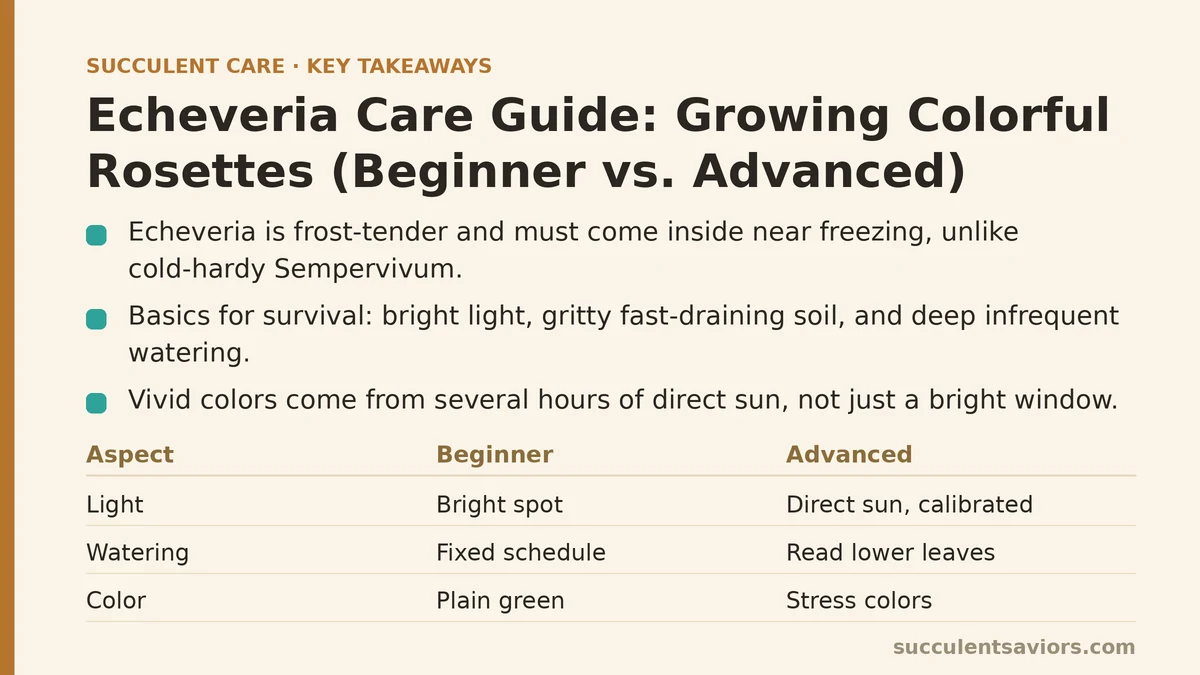
Echeveria and Sempervivum get mixed up constantly, and the confusion causes real problems. Sempervivum (“hens and chicks”) is cold-hardy and can live outdoors year-round in freezing climates. Echeveria is not. It’s a frost-tender genus from Mexico and Central America that needs to come inside the moment temperatures dip near freezing. Treat an Echeveria like a Sempervivum and you’ll lose it by January.
That single mix-up is a good entry point into a bigger truth about this genus: Echeveria is one of the most forgiving succulents to keep alive, but one of the hardest to keep looking good. Plenty of collections are full of pale, stretched, loosely-formed rosettes that are technically healthy but nowhere near their potential. The gap between “surviving” and “photo-worthy” is almost entirely a matter of moving from beginner habits to advanced ones.
The Baseline: What Keeps an Echeveria Alive
Before refining anything, a rosette needs the fundamentals in place. This is the beginner tier, and it’s not to be dismissed — most Echeveria deaths trace back to skipping one of these basics.
Bright light, well-draining soil, and infrequent, deep watering form the foundation. Echeveria wants at least four hours of direct or very bright indirect light daily. It wants a gritty, fast-draining mix, not standard potting soil. And it wants to dry out completely between waterings rather than sit in damp soil. Get these three things right and most Echeverias will hang on for years, even if they never look spectacular.
That’s where most new growers stop. Understandably so — a living plant feels like success. But an Echeveria that’s merely surviving and one that’s thriving look almost nothing alike, and the differences come down to a handful of specific adjustments.
Light: “Bright Spot” vs. “Calibrated Intensity”
Beginner approach: Put the plant near a window described as “bright” and consider the job done.
Advanced approach: Recognize that Echeveria color intensity is directly tied to light intensity, not just light presence. The vivid purples, pinks, and blues you see in nursery photos are largely a stress response to strong, direct sun — a defense mechanism the plant produces to protect its tissue from UV exposure. A rosette in merely “bright” indirect light will often revert to plain green or pale blue-green, with the rosette shape loosening as the leaves reach outward.
To get that saturated color at home, Echeveria typically needs several hours of direct sun, ideally morning or early afternoon sun that isn’t scorching. Indoors, this usually means an unobstructed south or west-facing window, or supplemental full-spectrum grow lighting placed close enough to mimic real intensity. Growers chasing color often keep a lux meter or simple grow light with a timer specifically for their Echeveria shelf, separate from lower-light succulents.
Watering: “Soak and Dry” vs. “Reading the Leaves”
Beginner approach: Water on a fixed schedule — every two weeks is a common rule of thumb — and check the calendar rather than the plant.
Advanced approach: Use the lower leaves as a gauge, not the calendar. Slightly soft, but not mushy or wrinkled, lower leaves usually mean the plant is in good hydration balance. Wrinkled leaves signal it’s time to water. Yellow, translucent, or mushy leaves near the base mean water has already been sitting too long and rot may already be underway.
The advanced grower also adjusts frequency by season and pot type. A terra cotta pot in a dry, sunny window might need water every seven to ten days in summer; the same plant in a glazed ceramic pot in a humid room could go three weeks. There is no universal number of days that works across setups — evidence from your own soil and leaves matters more than any generic schedule. This is often the single biggest reason two people following “the same” watering advice get opposite results.
Soil and Repotting: “Succulent Mix From a Bag” vs. “Built for Drainage Speed”
Beginner approach: Buy a bag labeled “succulent and cactus soil” and use it straight from the package.
Advanced approach: Test how fast that bagged mix actually drains, and amend it if needed. Many commercial succulent soils still hold water longer than an Echeveria’s shallow, fine root system prefers, especially once they’ve been packed into a pot for a year. Advanced growers typically cut the bagged mix with 30-50% mineral grit — pumice, perlite, or coarse sand — to speed up drainage further and add stability against overwatering mistakes.
Repotting habits differ too. A beginner repots only when a plant is clearly rootbound or dying. An advanced grower repots on a roughly annual schedule regardless, refreshing compacted soil, checking roots for early rot, and using the opportunity to remove dead lower leaves that trap moisture and invite pests against the stem.
Shape and Color Maintenance: “Let It Grow” vs. “Actively Shaping the Rosette”
Beginner approach: Let the plant do whatever it does, and accept a stretched or lopsided rosette as just how the plant turned out.
Advanced approach: Treat stretching (etiolation) as a fixable, light-driven problem rather than a fixed trait. A rosette that’s reaching toward one side of a window, or growing a visible gap between leaves, is telling you the light source is inadequate or one-directional. The fix isn’t cosmetic pruning alone — it’s rotating the pot every few days for even exposure, and in more advanced cases, beheading and re-rooting a badly stretched rosette to restart it compactly under better light.
Color maintenance follows the same logic. If a once-vivid Echeveria has faded to green, the advanced response isn’t fertilizer or misting — it’s simply more direct light, applied gradually so the leaves aren’t shocked or sunburned by a sudden jump in intensity.
Reading Symptoms: Beginner vs. Advanced Interpretation
Symptom: Rosette looks loose, with leaves pointing outward and downward instead of curling in tightly.
- Beginner read: “That’s just this variety’s natural shape.”
- Advanced read: This is almost always a light problem. Tight, cupped rosettes are a sign of strong light; loose, open ones signal the plant is stretching for more.
Symptom: Lower leaves are shriveling while the top of the rosette looks fine.
- Beginner read: “The plant is dying from the bottom up.”
- Advanced read: This is typically just thirst — normal water cycling, not decline. It’s time to water, not time to worry.
Symptom: A long, bare stem has developed beneath the rosette (a “neck”).
- Beginner read: “This is just how old Echeverias look.”
- Advanced read: This is etiolation from insufficient light, and it’s fully correctable by beheading the rosette, letting the cutting callus for a few days, and re-rooting it in fresh soil under stronger light.
Quick Reference: Beginner vs. Advanced Echeveria Care
| Care Aspect | Beginner Approach | Advanced Approach |
|---|---|---|
| Light | Any “bright” window | Several hours of direct sun or a close, calibrated grow light |
| Watering | Fixed calendar schedule | Judged by leaf firmness and soil dryness |
| Soil | Bagged succulent mix as-is | Bagged mix amended with extra grit for faster drainage |
| Shape | Accepted as-is | Rotated regularly; stretched rosettes beheaded and restarted |
| Color loss | Ignored or blamed on the variety | Diagnosed as a light-intensity issue and corrected gradually |
Most Echeveria problems aren’t really plant problems — they’re gaps between what the plant needs to merely survive and what it needs to look the way it does in the photo that made you want one in the first place. Closing that gap rarely requires more effort, just more precise attention to light, water timing, and soil drainage.
If you had to pick one area to upgrade first — light intensity, watering habits, or soil drainage — which do you suspect is holding your rosettes back the most?
Related guides: Common Echeveria Care Mistakes and How to Fix Them, How to Tell Succulent Species Apart: A Beginner vs. Advanced Identification Guide, and Lithops Care Guide: A Step-by-Step Approach to Growing Living Stones.