The ghost plant (Graptopetalum paraguayense) is a rosette-forming succulent native to Mexico, known for its pale, opalescent leaves that shift from dusty gray-blue to soft pink and lavender under strong light. It is often mistaken for Echeveria, but its stems are more sprawling, its rosettes are looser, and its tolerance for imperfect conditions is far greater.
That resilience is the plant’s defining trait. It survives neglect, recovers from poor soil, and roots readily from almost any detached leaf. But surviving and thriving are two different outcomes. This guide ranks the five most consequential elements of Graptopetalum care by how much they influence the plant’s health and appearance—from the non-negotiable to the merely important.
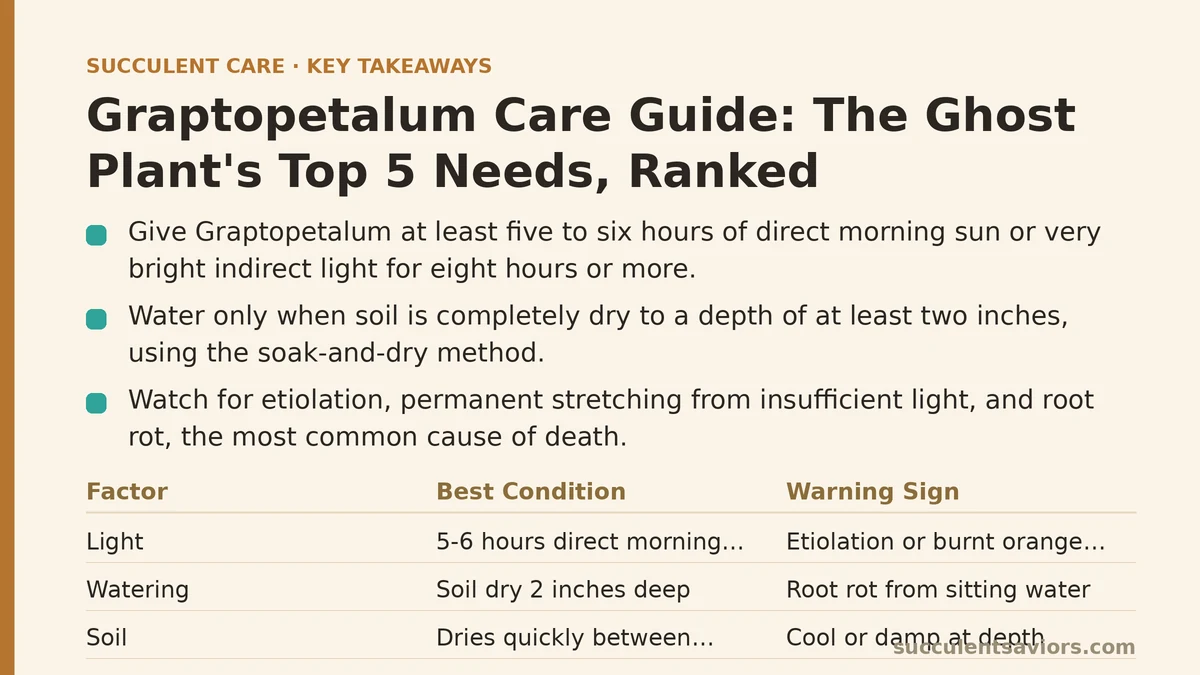
1. Light: The Single Highest-Impact Variable
No other factor determines a ghost plant’s appearance as completely as light. This is a full-sun succulent in the wild, and it performs best with at least five to six hours of direct morning sunlight or very bright indirect light for eight hours or more.
The signs of insufficient light are unmistakable. The rosettes stretch apart from each other along the stem—a condition called etiolation—and the internodes (the gaps between leaves) grow long and pale. The leaves lose their pink blush and revert to a flat, washed-out gray-green. This stretching is permanent; the compact form does not return once it is lost, though new growth at the tip will become tighter once light improves.
The signs of too much light are equally clear, though less common indoors. Leaves may turn a deep, almost burnt orange or develop brown, crispy patches on their upper surfaces, particularly during summer afternoon heat combined with intense, unfiltered sun. The fix is simple: move the plant to a spot with morning sun and afternoon shade, or place it behind a sheer curtain.
In practice, the best placement for most households is a south-facing windowsill, with a west-facing window a close second. If your space has neither, a full-spectrum grow light run for ten to twelve hours a day, positioned six to twelve inches above the plant, will replicate outdoor conditions well enough to keep the rosettes compact and the colors vivid.
2. Watering: The “Soak and Dry” Method, Practiced Correctly
The ghost plant stores water in its plump leaves, and it prefers to draw from those reserves rather than from constant soil moisture. This means the watering schedule is condition-based, not calendar-based.
Water only when the soil is completely dry to a depth of at least two inches. In a typical home environment, this works out to every ten to fourteen days during the growing season (spring and fall) and every three to five weeks in winter, but the dry-down time varies with pot size, soil mix, temperature, and humidity. Check the soil with a wooden skewer or your finger before every watering. If the soil feels cool or damp at depth, wait.
When you do water, use the soak-and-dry method: water thoroughly at the base of the plant, soaking the entire root ball, and allow all excess water to drain completely from the pot. Do not water again until the soil has returned to bone-dry. Leaving the plant sitting in a tray of water, or watering on a fixed schedule regardless of soil condition, is the fastest route to root rot—which is the single most common cause of death for this species, despite its otherwise tough reputation.
One distinctive signal deserves attention: when underwatered, the lower leaves become wrinkled and feel soft rather than firm. This is the plant’s way of asking for water. Take it as a cue to water, but check the soil first to confirm it is dry, because wrinkled leaves can also appear with overwatering once root rot has begun to inhibit uptake.
3. Soil and Drainage: A Gritty Mix That Doesn’t Hold Moisture
The ghost plant’s roots are shallow and sensitive to waterlogging. The potting medium must be coarse, free-draining, and quick to dry, mimicking the rocky, well-drained slopes where the plant grows in the wild.
A reliable recipe is one part standard succulent soil to one part coarse perlite or pumice. This produces a mix that holds enough moisture to support root growth but drains rapidly, leaving no standing water around the roots. For very humid environments or for growers who tend to overwater, increase the grit to two parts perlite or pumice per one part soil.
The pot matters as much as the soil. Choose a container with at least one drainage hole—preferably several—and avoid glazed pots without holes, which trap water at the root zone. Terra cotta is an excellent choice, as it wicks moisture away from the soil and dries out faster than plastic. Pot size also influences health: a pot that is too large holds more wet soil for longer, increasing rot risk. Keep the pot just slightly larger than the root ball, and repot every two to three years or when the plant has clearly outgrown its container.
4. Temperature and Hardiness: Knowing Its Limits
Ghost plants are remarkably cold-hardy for a Mexican succulent, tolerating temperatures down to about 20°F (-6°C) when kept dry, which makes them a viable outdoor choice in USDA zones 9 to 11. Some growers in cooler zones, down to zone 8, report success in protected, south-facing spots with sharp drainage. The dryness of the soil matters far more than the air temperature: a plant sitting in wet soil at 30°F is far more likely to suffer frost damage than one in dry soil at the same temperature.
For indoor growers, the main temperature concern is avoiding extremes. Position the plant away from drafty windows in winter, which can chill the roots, and away from heating vents in summer, which dry the leaves unevenly and stress the plant. A stable room temperature between 60°F and 80°F (15°C to 27°C) supports steady growth, with a cooler, drier rest period in winter matching the plant’s natural seasonal slowdown.
5. Propagation and Maintenance: The Easiest Rewards
Ghost plants propagate with almost absurd ease, which makes this the most satisfying aspect of their care. A single detached leaf, callused for two to three days, placed on top of moist soil, will put out roots and a tiny rosette within two to four weeks. Do not bury the leaf; simply lay it flat on the soil surface with its healed end pressed slightly into the medium. Keep the soil lightly moist but not wet, and provide bright, indirect light. New plants can be potted on once the original leaf withers away.
Stem cuttings work just as well. Snip a healthy rosette with a few inches of stem, allow the cut end to callus for three to five days in a dry spot, then plant it in gritty soil. Water sparingly for the first week, then treat it like an established specimen.
Routine maintenance is straightforward: remove dead leaves from the base of the plant to improve airflow around the stem, and repot when the rosettes have filled the pot or when the stem becomes leggy. Leggy stems can be trimmed, and the cut tops rerooted, while the remaining stem pushes out new side rosettes—an endlessly renewable cycle.
Quick Comparison: The Five Needs at a Glance
| Priority | Need | Key Practice | Most Common Failure |
|---|---|---|---|
| 1 | Light | 5–6+ hrs direct morning sun or grow light | Etiolation, pale leaves, lost pink tones |
| 2 | Watering | Soak-and-dry, condition-based checking | Root rot from fixed-schedule overwatering |
| 3 | Soil & Drainage | Gritty mix, pot with drainage hole | Waterlogged roots, mush at the soil line |
| 4 | Temperature | Avoid frost + wet feet; stable indoor temps | Frost kill or thermal stress |
| 5 | Propagation | Leaf or stem cuttings, callus before planting | Rotting from overwatering fresh cuttings |
Putting the Ranking to Work
The order of this list is deliberate. Light and water are the two levers that most dramatically affect a ghost plant’s growth and loss risk; they take priority over every other factor. Soil quality ranks third because it determines how forgiving your watering habits can be—good soil will forgive a missed check, while poor soil will punish it. Temperature and propagation are lower not because they are unimportant, but because they are easier to manage once the first three are right.
Start with light. Move your plant to the brightest windowsill you can manage, and let it sit for two weeks. Watch for the rosette tips to flatten slightly in search of more light, and for new leaf growth to appear closer together on the stem. Then adjust watering to match the soil, not the calendar. The pink edges and dusty lavender tones that follow are the plant’s way of telling you everything is in balance.
Which of these five needs have you found the hardest to get right with your ghost plant—keeping the colors vivid, or holding back on watering when the leaves start to wrinkle?
Related guides: Aeonium Care Guide: Troubleshooting Common Problems, Agave Care Guide: Types and Care Tips for a Thriving Collection, and Aloe Vera Care Guide: Growing Tips and Healing Uses.