After reading this, you will be able to choose the right succulents for a specific office spot, group and scale them like a designer would, pick containers that survive real workplace conditions, and set up a watering routine that does not depend on someone remembering. The advice below is built around what office environments put plants through—fluorescent light, dry HVAC air, weekend neglect, and cleaning crews—rather than what looks good in a staged photo.
Office succulent styling is a design discipline with its own logic. Designers are not simply buying pretty plants; they are solving problems of light, maintenance labor, visual weight, and durability. Understanding those constraints is what separates a shelf of struggling plants from a display that holds up for years.
Myth #1: Any Succulent Works in Any Office
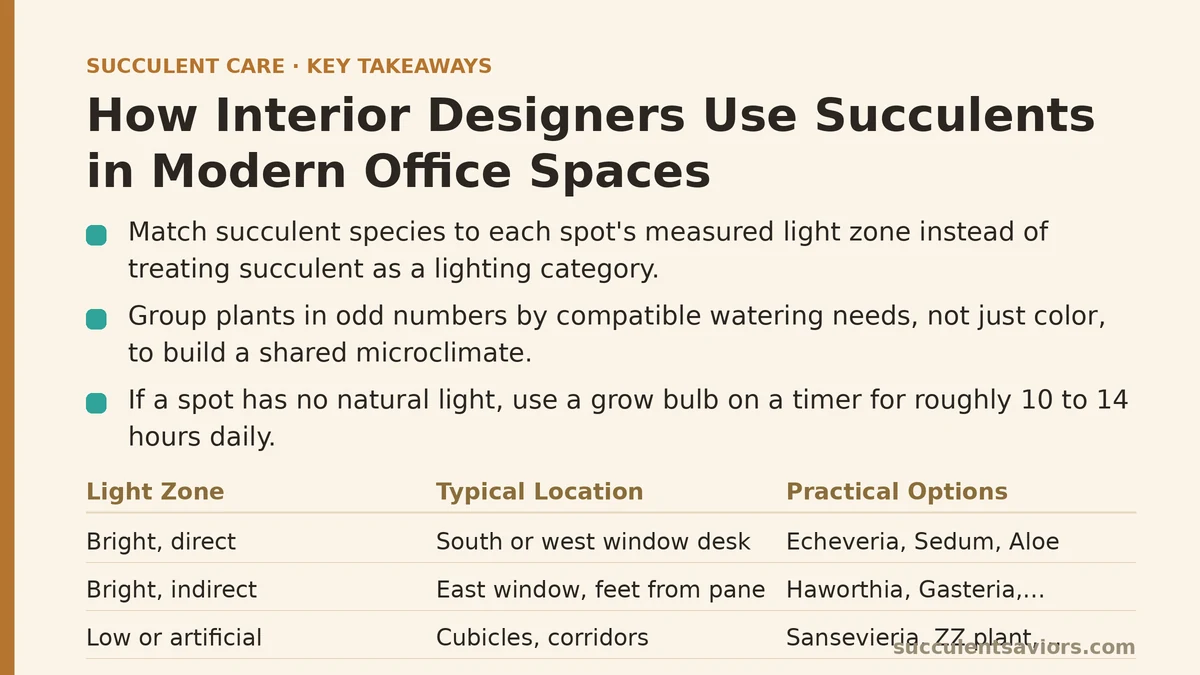
The single most common assumption is that “succulent” is a lighting category. It is not. A succulent is a water-storage strategy, and species within that group range from full-sun desert plants to forest-floor dwellers that burn in direct light.
The reality: Designers match species to the light zone of the specific spot, not to a general office aesthetic. A south-facing conference room and an interior corridor with no windows are completely different assignments. Placing an Echeveria in a windowless breakout area is a guaranteed decline, no matter how carefully it is watered.
The fix: Before choosing a plant, measure the spot. Note how many hours of natural light reach it, whether the light is direct or filtered, and how far it sits from the nearest window. Interior offices typically fall into three rough zones that designers work from:
| Light Zone | Typical Location | Practical Succulent Options | What to Avoid |
|---|---|---|---|
| Bright, direct | South or west window desk, atrium | Echeveria, Sedum, Graptopetalum, Aloe | Haworthia (bleaches), String of Pearls (scorches) |
| Bright, indirect | East window, a few feet back from a sunny pane | Haworthia, Gasteria, Pachyphytum, Crassula | Full-sun Echeveria (stretches) |
| Low or artificial only | Interior cubicles, corridors, windowless rooms | Sansevieria, ZZ plant, Gasteria, Haworthia | Most rosette succulents (etiolate fast) |
If a spot has no natural light at all, be honest about it. A grow bulb in a desk lamp is a reasonable workaround, but it has to stay on for roughly 10–14 hours a day to matter. Designers build that into the electrical plan; you can replicate it with a simple timer.
Myth #2: Grouping Is Just About Looks
Grouping plants tightly is a strong visual move, and it does look intentional. But the reason designers cluster succulents goes beyond composition.
The reality: Grouped pots create a shared microclimate. Plants placed close together raise humidity slightly around each other and buffer temperature swings, which helps in dry, air-conditioned rooms. Grouping also hides the awkwardness of individual small pots and lets you use scale—a trio of matching planters reads as one intentional object rather than three random plants.
The fix: Group in odd numbers (three or five), vary the heights, and keep the species compatible in water needs. A common mistake is mixing a thirsty Crassula with a drought-tolerant Lithops in the same cluster and watering everything on one schedule. Designers cluster by watering group, not just by color. If you want a mixed look, choose plants from the same light zone and similar water rhythm, then use pot size to create the height variation.
Sensory check: run your hand near a grouped display. If the air feels noticeably drier directly above the plants than at the edge of the cluster, you have spaced them too far apart to gain any humidity benefit.
Myth #3: The Container Is a Decor Decision
In office settings, the pot does more work than the plant in some ways. It has to survive being knocked, wiped, and occasionally overwatered by whoever is on plant duty that week.
The reality: Designers choose containers for drainage and weight. A heavy ceramic pot resists tipping when someone bumps a desk, and a pot with a proper drainage hole and a saucer prevents water from pooling at the roots—the leading cause of office succulent death. Sealed decorative pots without drainage look clean but trap moisture, and in a low-light office that moisture sits far longer than it would outdoors.
The fix: Prioritize three things: a drainage hole, enough weight to stay put, and a material that does not scratch easily. Terracotta breathes and dries fast, which suits overwaterers. Glazed ceramic holds moisture longer and looks more polished for reception areas. Fabric or woven planters need a plastic nursery pot inside them with a saucer—never plant directly into fabric.
For a desk or shared surface, a saucer is non-negotiable. Cleaning crews wipe surfaces, and a pot that drips onto a desk gets moved, removed, or complained about.
Myth #4: A Weekly Watering Schedule Keeps Office Succulents Alive
The calendar approach is the most common failure pattern in offices. Someone writes “water plants Friday” on a whiteboard, and the plants get watered whether they need it or not.
The reality: Succulents need water based on soil dryness and the plant’s signs, not the day of the week. In a climate-controlled office, soil can stay wet for two weeks or more in low light. Watering on a fixed schedule in that setting is how root rot starts. The reverse problem is just as common: a plant near a heating vent dries out in days and a weekly schedule is far too slow.
The fix: Replace the calendar with a simple soil check. Push a finger or a wooden skewer an inch into the soil. If it comes out dry, water thoroughly and let it drain. If it comes out cool and damp, wait. Designers often simplify this by choosing one person to do the check weekly and water only those plants that pass the dryness test. For a larger office, a moisture meter takes the guesswork out of the routine and is easier to hand off to a facilities team.
Two practical options for a workplace:
- A designated plant steward: One person checks and waters weekly, with a written note of which pots were watered. Best for small offices where everyone knows each other.
- Self-watering or sub-irrigation planters: These reduce frequency and forgiveness for missed weeks, but they still need monitoring—succulents can rot in a constantly moist reservoir, so choose ones with an air gap and use them mainly for the thirstier species.
There is no universal winner. A steward works well when you have engagement; self-watering works when you have none, provided you pick the right species.
Myth #5: More Plants Always Read as “Designed”
Abundance is tempting, especially when a blank office wall is begging for something. But a crowded shelf of mismatched succulents reads as clutter, not design.
The reality: Designers use restraint and repetition. A single large statement plant—an established Aloe or a sculptural Sansevieria—often does more for a space than a dozen small pots. Repetition of one species in matching containers creates a rhythm that the eye reads as deliberate. Variety in species and pot styles at the same scale creates visual noise.
The fix: Pick one anchor plant per zone and build around it. Repetition of form—same pot, same species, different heights—is the easiest way to make a small budget look intentional. Keep the palette tight: two or three species across a whole floor will read as more designed than ten.
Watch for the trap of filling every empty surface. Empty space is part of the composition. A reception desk with one well-scaled planter and nothing else looks more considered than the same desk crowded with five small pots.
What Designers Plan For That Most People Forget
Three workplace realities quietly shape every good office succulent design:
- Weekends and holidays. Plants go unattended. Species that tolerate a missed watering are safer than delicate ones. This is a strong argument for Haworthia, Gasteria, and Sansevieria over fussier rosettes.
- HVAC airflow. Heating and cooling vents dry the air and the soil fast. A plant directly in a vent’s path will struggle regardless of species. Designers place plants out of the direct airstream, and you should too.
- Cleaning routines. Pots get moved, wiped, and occasionally sprayed with cleaning products that drift onto leaves. Sturdy, heavy pots with saucers survive this; lightweight or unglazed pots that stain are a liability.
A quick pre-purchase checklist for any office spot:
- How many hours of real light does this position get, and is it direct or filtered?
- Is there a vent, radiator, or door draft within a couple of feet?
- Will someone check soil moisture at least weekly, or does the plant need to be nearly self-sufficient?
- Is the surface bumped or wiped often, and does the pot need a saucer and weight?
- Does this plant fit the scale of the surface, or will it look lost or crowded?
The Takeaway
Office succulent design comes down to matching plants to real conditions rather than styling them to a mood board. Light zone first, watering group second, container and scale third—and restraint throughout. Get those four things right and even a modest office display will look intentional and last longer than a seasonal refresh. Get them wrong and no amount of careful watering will compensate.
Which office spot is giving you the most trouble—a bright window that scorches everything, or an interior corner with no natural light at all?
Related guides: Succulent Light Requirements Explained, Choosing the Right Pot and Soil for Succulents, and Low-Light Succulents That Thrive Indoors.