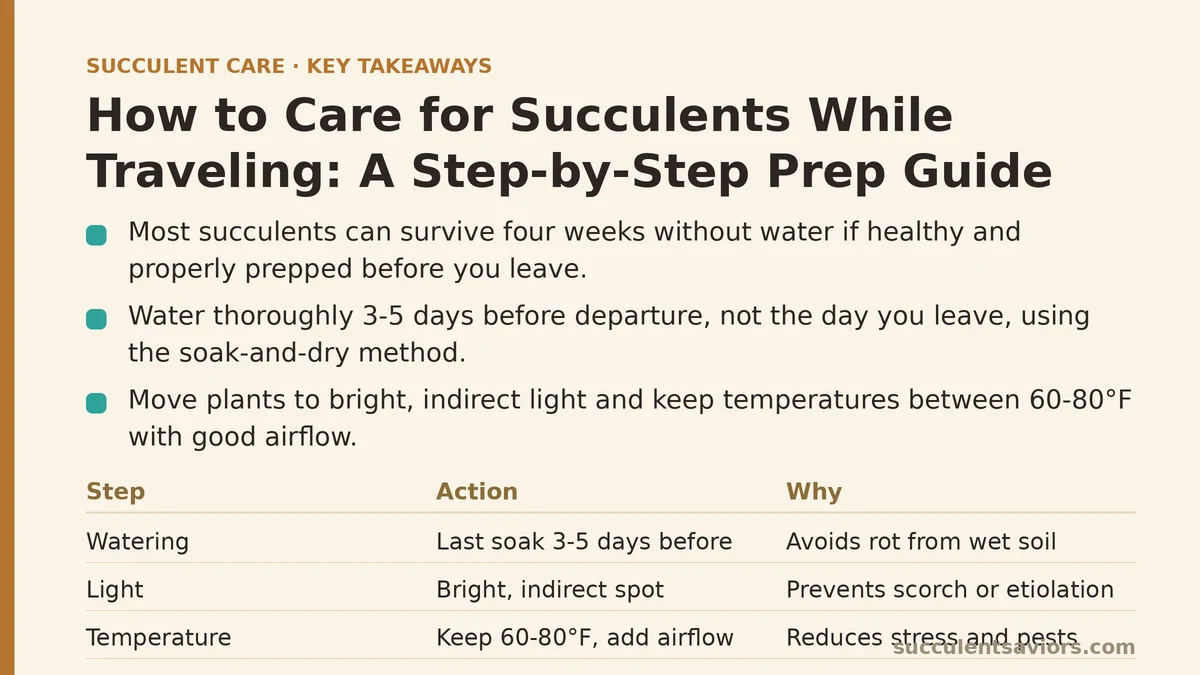
Most succulents can survive four weeks without water, and in some cases even longer, as long as they were healthy and properly prepped before you left. That single fact surprises almost everyone who walks into the shop worrying about their two-week vacation. The instinct is to arrange for someone to come water, mist, or otherwise fuss over the plants while you’re gone. In reality, that well-meaning helper is far more likely to kill your succulents through overwatering than your absence ever would through neglect.
The real work of travel-proofing a succulent collection happens before you leave, not during your trip. Below is the process I walk customers through every time they mention an upcoming trip, broken into clear steps you can follow regardless of how long you’ll be away.
Step 1: Time Your Last Watering Correctly
Don’t water the day you leave. Instead, plan your last watering session for three to five days before departure, using the full soak-and-dry method: water thoroughly until it drains from the bottom of the pot, then let the excess drain away completely.
The goal here is precision, not generosity. You want the soil to be moist enough to sustain the plant through the first stretch of your absence, but dry enough by the time you actually leave that there’s no standing moisture sitting around the roots. A succulent that leaves home with slightly damp (not soggy) soil handles two to three weeks away far better than one that leaves with wet soil, which invites rot before you’ve even boarded the plane.
Step 2: Assess and Adjust the Light Situation
Succulents kept on a sunny windowsill in July can scorch if left unattended during a heatwave, since nobody is there to notice and move them. Conversely, moving them somewhere too dim to avoid burn can trigger etiolation over a long trip.
The fix is a middle-ground spot: bright, indirect light that won’t intensify into direct scorching sun for hours at a stretch, but still gives the plant enough energy to sit dormant-ish without stretching. A spot a few feet back from a south- or west-facing window, or directly in an east-facing one, usually works. If you normally rely on a grow light, put it on a timer so the schedule holds steady even though you won’t be there to flip the switch.
Step 3: Consider the Room’s Temperature and Airflow
Before you leave, think about what happens to your home while you’re away. If you’re adjusting the thermostat to save energy, don’t let the house swing into extremes. Succulents tolerate a fairly wide range, but a house that climbs into the 90s with no air circulation for two weeks straight can stress plants and invite pests, while a house dropping below 50°F risks cold damage for tropical varieties like some Echeveria hybrids.
Set the thermostat to a moderate range, somewhere between 60-80°F, and leave a window cracked or a fan on low if the space tends to get stuffy. Good airflow also helps soil dry evenly, which matters more than usual since nobody will be there to notice a slow-draining pot.
Step 4: Repot Anything in Questionable Soil
If you’ve been meaning to repot a succulent that’s sitting in old, compacted, or moisture-retentive soil, do it now rather than after you get back. Old potting mix breaks down over time and holds water longer than it should, which is precisely the kind of risk you don’t want compounding while you’re away for weeks.
Fresh, well-draining succulent soil paired with a pot that has drainage holes is your best insurance policy. If you’re not sure whether a pot qualifies, this is the moment to switch it out, not after you’ve noticed mushy leaves upon returning home.
Step 5: Group Plants by Water Needs, Not by Convenience
It’s tempting to cluster all your succulents together in one spot for easy care, but grouping by light and water needs matters more when you won’t be monitoring them daily. Put your winter-growing Haworthias and Aloes together in one zone, and your dormant summer-growers like Echeveria and Sempervivum in another, since their tolerance for drought and their light requirements can differ.
This also makes it easier if you do enlist help: a friend checking in only needs to understand one rule per grouping rather than memorizing the needs of fifteen individual pots.
Step 6: Decide Whether You Actually Need a Plant Sitter
For trips under three weeks, most established succulents in terracotta or another breathable pot don’t need anyone to intervene at all. If you’re gone longer, or if you’re nervous, the safest instruction to give a sitter is almost insultingly simple: don’t water unless the soil is bone dry all the way through, and when in doubt, don’t.
Overwatering by a well-intentioned sitter is the single most common cause of a succulent dying while its owner is away. If you must delegate watering, consider setting out pre-measured amounts and marking a calendar with the earliest date they’re allowed to water, so instinct doesn’t override the plan.
Step 7: Skip the Gadgets Unless You Know Why You Need Them
Self-watering globes, capillary mats, and drip systems are marketed heavily around travel season, but most succulents don’t need them for trips under a month. These tools are designed for plants that need consistent moisture, which is the opposite of what a succulent wants. If you use one anyway, the soil can stay damp for the entire trip, and you’ll come home to soft, translucent leaves instead of a plant that simply looks a little smaller and thirstier than when you left.
If you’re gone for six weeks or more, a very slow-drip system set to release water sparingly, tested for at least a week before you leave, can be worth the risk. For anything shorter, trust the plant’s own water reserves instead.
Quick Reference: Pre-Trip Succulent Checklist
| Step | Action | Why It Matters |
|---|---|---|
| Watering timing | Water 3-5 days before leaving, then let it dry | Avoids leaving soil wet during your absence |
| Light placement | Move to bright, indirect light | Prevents both scorching and etiolation |
| Temperature | Keep home between 60-80°F with airflow | Prevents heat stress and slow soil drying |
| Soil and pots | Repot anything in old or compacted soil | Reduces rot risk from moisture retention |
| Grouping | Sort plants by water/light needs | Simplifies care for any helper, or for yourself later |
| Sitter instructions | “Don’t water unless bone dry” | Prevents the most common cause of travel-related death |
| Gadgets | Skip self-watering tools under a month | Avoids overwatering from unnecessary devices |
A Final Thought Before You Pack Your Bags
Succulents are, in many ways, better suited to your absence than your presence. Their entire survival strategy is built around storing water and waiting out dry stretches, which is exactly the situation a two- or three-week trip creates. The plants most likely to struggle aren’t the ones left alone—they’re the ones whose well-meaning owners arrange for extra watering “just in case.”
Trust the prep work, trust the plant’s own reserves, and you’ll likely come home to succulents that look only slightly thirstier than the day you left, not worse for wear.
Have you ever come home from a trip to find your succulents thriving despite total neglect, or did a well-intentioned plant sitter cause more damage than the trip itself?
Related guides: Succulent Watering Mistakes: A Troubleshooting Chart for Common Problems, How to Get Colorful Succulents: A Step-by-Step Sun Stress Guide, and Lithops Care Guide: A Step-by-Step Approach to Growing Living Stones.