By the time you finish this guide, you’ll know how to look at a cracked or split succulent leaf and immediately identify whether it’s a watering problem, a sunburn issue, or simple physical damage—and you’ll know exactly what to do about each one. Cracked leaves alarm people more than almost any other succulent symptom, mostly because the damage looks so sudden and severe. The good news is that most cases are fixable, and the ones that aren’t fixable are at least easy to prevent going forward.
Use this as a checklist. Find the symptom that matches your plant, confirm the cause, and apply the fix.
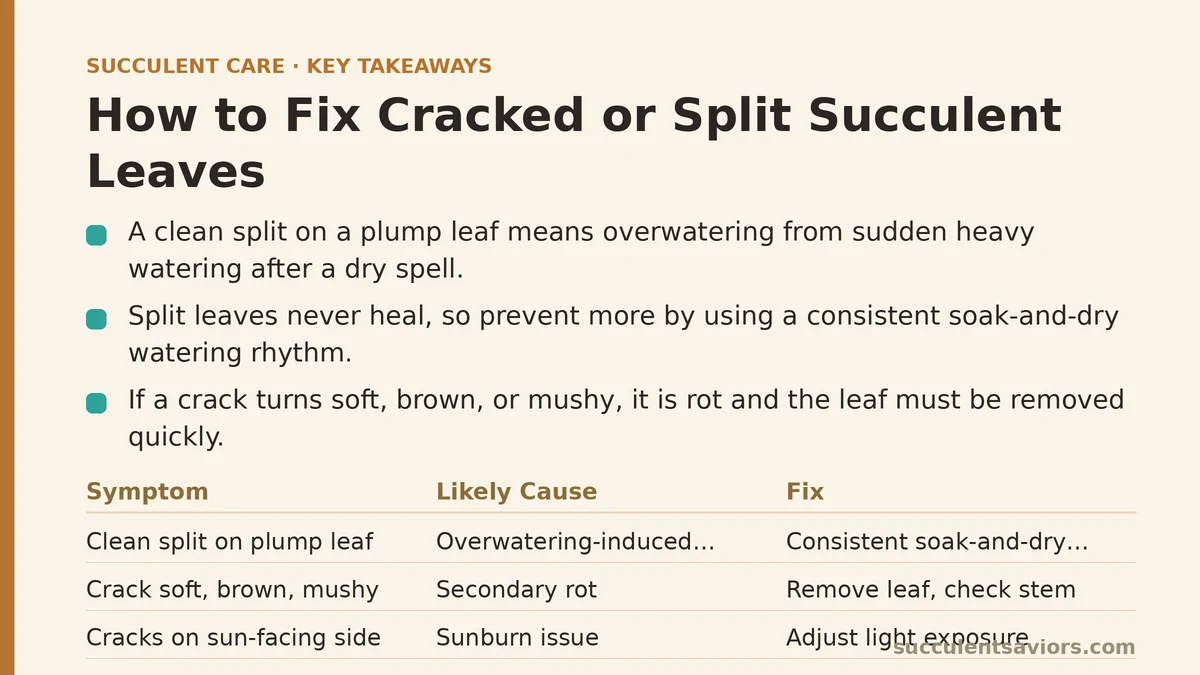
Symptom: A Split Running Down the Side of a Plump, Otherwise Healthy Leaf
The leaf itself still looks firm and full of water. There’s no discoloration, no softness, just a clean crack or split along its length, almost like the skin gave way under pressure.
Likely Cause: This is classic overwatering-induced splitting, and it happens more often than people expect. Succulent leaves are essentially water storage tanks with a limited amount of stretch in their outer skin. When a plant has been kept dry for a while and then receives a heavy, sudden watering, the roots absorb water faster than the leaf tissue can expand to accommodate it. The internal pressure builds until the leaf’s surface simply splits open.
The Fix: There isn’t a way to reverse a split once it’s happened—the leaf will keep that scar for the rest of its life. But you can stop it from happening to the rest of the plant. Go back to a consistent soak-and-dry watering rhythm rather than letting the soil swing between bone-dry and saturated. If you know a long dry spell is coming (a vacation, a busy month), water lightly and more frequently leading up to it rather than dumping a large amount all at once when you return. The damaged leaf itself is usually fine to leave in place; it will still photosynthesize normally unless the crack has invited rot, which brings us to the next symptom.
Symptom: The Crack Has Turned Soft, Brown, or Mushy Around the Edges
What started as a clean split now looks like it’s spreading. The tissue near the crack has gone translucent, brown, or soft to the touch, and the damage seems to be creeping outward day by day.
Likely Cause: Secondary rot. An open crack is essentially a wound, and wounds are entry points for bacterial and fungal pathogens, especially when moisture lingers on the leaf surface or in the surrounding soil. Once rot sets in at the site of a crack, it can spread through the leaf and, in some cases, travel back into the stem.
The Fix: Move quickly here—this is not a symptom to monitor for a week and see how it goes. Remove the affected leaf entirely, cutting or gently twisting it off at its base with clean hands or sterilized scissors. Don’t try to save a leaf that’s already rotting; the goal now is to protect the rest of the plant. Check the stem where the leaf was attached for any softness or discoloration, and if you find it, keep trimming back until you reach firm, healthy tissue. Let the wound dry and callus for a couple of days before returning the plant to its normal watering routine, and hold off on watering during that callusing period entirely.
Symptom: Cracks or Splits Only on the Sun-Facing Side of the Plant
The damage is concentrated on one side of the leaves, often the side that was recently exposed to a stronger light source, and it may be accompanied by a bleached, tan, or reddish-brown patch right at the crack.
Likely Cause: Sunburn combined with rapid, uneven moisture loss. When a leaf is scorched, the tissue on that side dies and dries out faster than the tissue behind it, and the difference in shrinkage between the damaged and healthy layers can cause the surface to crack or peel. This is especially common after moving a plant outdoors for the season, or relocating it too abruptly to a brighter windowsill without any transition period.
The Fix: The cracked, sun-damaged tissue won’t heal or change color back, so accept that those specific leaves are cosmetically marked for good. What matters is stopping further burn. Move the plant to a spot with slightly less intense direct light, or introduce filtered shade during the harshest afternoon hours. If you’re transitioning a succulent to a sunnier environment, do it gradually over one to two weeks, adding an hour or two of direct exposure at a time rather than making the full jump immediately. New growth that emerges under the corrected light conditions should come in undamaged.
Symptom: Small, Shallow Cracks Appear Near the Leaf Tip, With No Discoloration
These cracks are thinner and more superficial than the splits described above, often clustered near the tips of the leaves, and the plant otherwise looks completely normal.
Likely Cause: Physical stress from handling, cold exposure, or minor mechanical damage. Leaf tips are the thinnest, most exposed part of the leaf, so they’re the first to show stress from a light frost, an accidental bump during a move, or even friction against a plant shelf or window screen.
The Fix: In most cases, these minor cracks are purely cosmetic and don’t require intervention beyond identifying and removing the source of contact or cold. Check whether the plant is touching a cold window pane at night, and if so, pull it back an inch or two. If the damage is from handling, simply be more careful when repotting or moving the plant in the future—succulent leaves are more brittle than they look, and even a gentle bump can leave a mark that lingers for months.
A Quick Word on Prevention
Nearly every cause of leaf cracking on this list comes down to sudden change: a sudden soak after drought, a sudden jump in light intensity, a sudden bump or temperature swing. Succulents are remarkably tolerant plants, but they respond far better to gradual adjustments than abrupt ones. Whenever you’re changing your watering schedule, your plant’s location, or its light exposure, try to phase the change in over a week or two rather than flipping the switch all at once. That single habit prevents the majority of the cracking issues described above before they start.
Troubleshooting Quick Reference
| Symptom | Likely Cause | Fix |
|---|---|---|
| Clean split, leaf still firm | Overwatering after a dry spell | Return to consistent soak-and-dry watering; leave the leaf in place |
| Crack turning soft or brown | Secondary rot at the wound site | Remove the leaf, trim back any soft stem tissue, let it callus before watering |
| Cracking on the sun-facing side | Sunburn and uneven moisture loss | Reduce direct light intensity; transition sun exposure gradually |
| Small cracks near the tip | Cold exposure or physical bump | Remove the source of contact or cold; handle the plant more gently |
Once you’ve matched your plant’s symptom to its cause, the fix is usually straightforward—the harder part is resisting the urge to overcorrect. Which of these symptoms matches what you’re seeing on your plant right now, and did the crack show up after a recent change in your watering or its spot in the house?
Related guides: Succulent Leaves Turning Translucent and Mushy: 5 Causes Ranked From Most to Least Likely, How to Treat Succulent Sunburn and Scorched Leaves, and Why Succulent Leaves Turn Mushy: Common Mistakes and Fixes.