Customers sometimes show a photo of a stunning, fiery-red Echeveria ‘Agavoides’ from a nursery, then point to their own perfectly healthy but uniformly green version at home. “What am I doing wrong?” he asked. “Mine is growing, but it’s just… green. It’s natural to worry that giving it more sun will just fry it.” He wasn’t doing anything wrong; in fact, he was doing everything right for basic survival. But he hadn’t yet learned the art of intentional, controlled stress—the key to unlocking a succulent’s most spectacular colors.
This guide isn’t about just keeping your succulents alive. It’s a precise, step-by-step process for transforming them from simply healthy to truly breathtaking, using the very same techniques that professional growers use to produce those eye-catching, vibrant specimens.
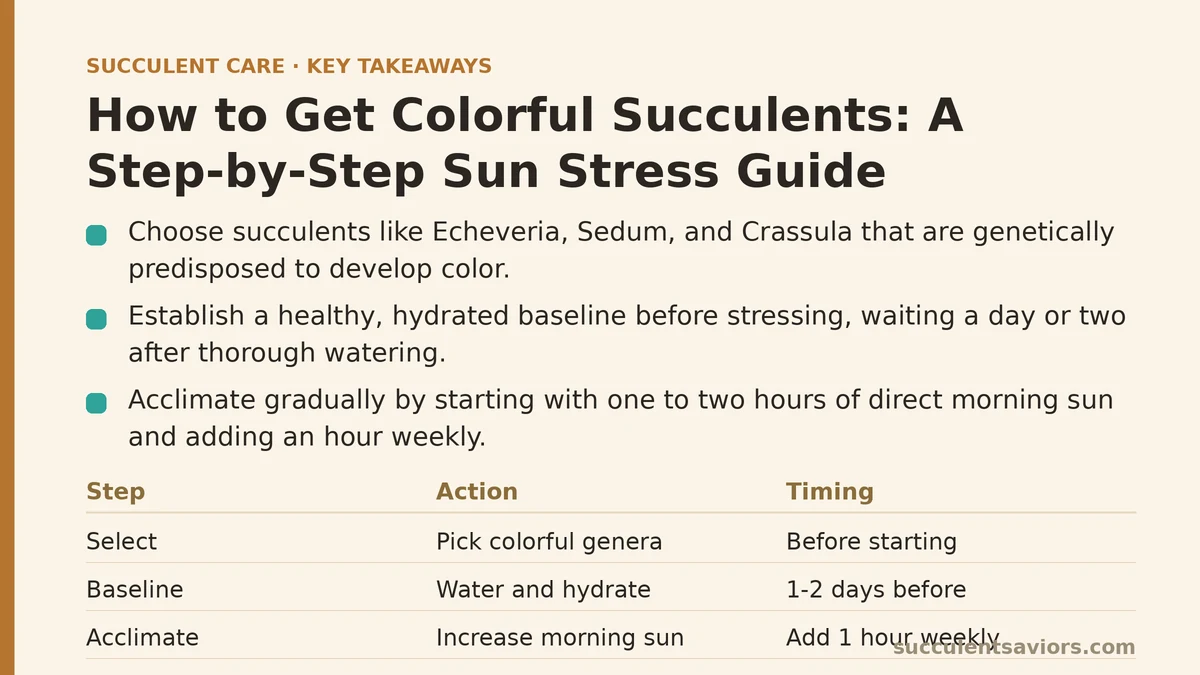
Step 1: Choose a Genetically Predisposed Succulent
Before you begin, you must understand a critical fact: not all succulents are created equal when it comes to color potential. No amount of stress will turn a deep-green Haworthia into a rainbow. The ability to produce vibrant anthocyanin (red/purple) and carotenoid (yellow/orange) pigments is written into the plant’s DNA.
Your best candidates for dramatic color transformation are genera known for their stress responses. Look to plants like Echeveria, Sedum, Crassula, Graptopetalum, Pachyphytum, and certain Kalanchoe and Aloe species. If you start with a plant that has the genetic potential for color, your chances of success are infinitely higher. A plant that is only ever green at the nursery will likely only ever be green for you.
Step 2: Establish a Healthy, Hydrated Baseline
This is the most important and often-skipped step. Attempting to stress a weak, newly-potted, or underwatered succulent is a recipe for disaster. Stressing a plant is like asking an athlete to perform; they must be healthy, conditioned, and hydrated first.
Before you begin increasing light, ensure your succulent is well-established in its pot with a strong root system. It should be fully turgid and hydrated. The ideal time to start is a day or two after a thorough watering, once the leaves are plump and firm. A thirsty, shriveled plant exposed to intense sun will scorch and desiccate almost immediately. You are aiming for controlled stress, not outright damage.
Step 3: Implement Gradual Light Acclimation
This is where patience and observation become your most valuable tools. The goal is to slowly increase the amount of direct sunlight the plant receives over a period of weeks, not days. A sudden move from a shaded windowsill to a full-sun afternoon balcony will cause sunburn.
Start by moving your plant to a location where it will receive just one or two hours of direct morning sun. Morning sun is less intense than afternoon sun and is the perfect starting point. Keep the plant there for a week, watching it closely. If it shows no signs of burning (see Step 4), you can increase the exposure. Move it to a spot with three hours of morning sun, or add an hour of late afternoon sun. Continue this incremental process, adding an hour or so of direct light each week, until you find the “sweet spot” where vibrant colors begin to emerge without any signs of damage.
Step 4: Learn to Differentiate Good Stress from Bad Sunburn
As you increase light, your plant will communicate with you. Your job is to learn its language. You are looking for the beautiful blush of healthy stress, not the pale patches of a burn.
Signs of Healthy Sun Stress:
- Colors intensify, often starting at the leaf margins and tips.
- Pinks, purples, reds, and oranges begin to appear or deepen.
- The plant’s growth becomes more compact and dense (the space between leaves, or internodes, shortens).
Signs of Unhealthy Sunburn (Damage):
- Pale white, yellow, or beige patches appear on the leaves, often on the surfaces most exposed to the sun.
- These patches can turn brown, black, and crispy over time.
- The damaged tissue will feel dry or papery and is permanent. The leaf is scarred.
If you see any signs of sunburn, immediately move the plant back to a less intense light setting. The burn marks won’t heal, but you can prevent further damage.
Step 5: Maintain Color with Water and Temperature Stress
Light is the primary driver of color, but it’s not the only one. Once you’ve found the right light balance, you can enhance and maintain those colors by using other controlled stressors.
Cooler temperatures, particularly in the evening, often intensify red and purple pigments. This is why many succulents look their absolute best in the spring and fall. Additionally, allowing the plant to get thoroughly dry between waterings contributes to the stress response. A constantly plump, well-watered succulent in moderate light will often remain green because it is “comfortable.” By combining bright light with less frequent watering (always following the soak and dry method, of course), you are signaling to the plant that it needs to produce its protective, colorful pigments. The color is, after all, a form of plant sunscreen.
Quick Reference: Stress vs. Damage
| Sign | Healthy Stress | Unhealthy Sunburn |
|---|---|---|
| Color | Rich pinks, reds, purples, oranges. | Pale white, yellow, or brown patches. |
| Texture | Leaf remains firm and healthy. | Damaged area becomes dry, crispy, and scarred. |
| Location | Often appears on leaf tips and margins. | Typically on the uppermost, most exposed leaf surfaces. |
| Outcome | Compact, vibrant, and healthy plant. | Permanent scarring and weakened plant. |
What This Means
I explained to the owner of the green Echeveria that his plant wasn’t “wrong,” it was just too comfortable. It had everything it needed to survive, so it had no reason to produce its vibrant stress colors.
We devised a simple plan. First, we made sure his plant was well-watered and plump. Then, we moved it from its bright but indirect spot to a patio table that got direct sun only until 11 AM. For the first week, that’s all we did. The next week, we moved it to a spot that got sun until 1 PM. By the end of the third week, the edges of the Echeveria’s leaves were blushing a deep crimson. He had successfully found the perfect balance of light for his specific environment, giving the plant enough stress to color up beautifully without ever causing a single burn mark. He learned it wasn’t a failure on his part, but a process he hadn’t yet been taught.
Which of your succulents has surprised you the most with its color transformation, and what do you think was the key factor—more light, cooler nights, or less frequent water? Related guides: Aeonium Care Guide: Troubleshooting Common Problems, Do Succulents Flower? Understanding Blooming, Ranked by What’s Really Stopping Yours, and Haworthia Care Guide: Solving Zebra Plant Problems.