Echeveria and Graptopetalum can look almost identical on a nursery shelf—both form tidy rosettes, both come in soft blues and dusty pinks—yet they’re different genera with different quirks. Sedum and Sedeveria cause the same confusion. If you’ve ever stood in the succulent aisle trying to match a tag to a plant that clearly doesn’t belong to it, you already know the problem this post is solving.
Identification isn’t about memorizing hundreds of Latin names. It’s about learning which features actually distinguish one plant from another, and which ones are red herrings. Below, here is a walkthrough of the myths that trip up most new growers, and the realities that separate a confident guess from an educated one.
Myth: If It Has a Rosette Shape, It’s an Echeveria
This is probably the single most common misconception in succulent identification. Echeveria has become something of a catch-all name, the way people call every tissue a Kleenex. Walk into most big-box garden centers and you’ll see rosette succulents labeled “Echeveria” regardless of what they actually are.
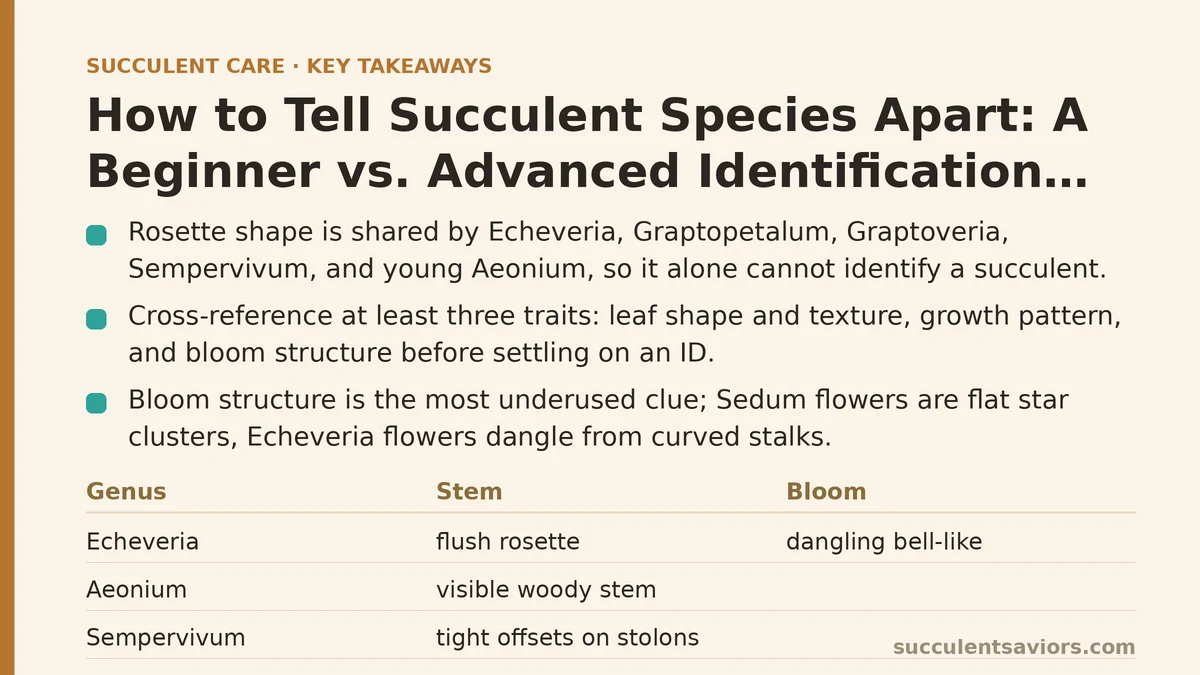
The Reality: Rosette shape is a growth habit shared by several unrelated genera, including Echeveria, Graptopetalum, Graptoveria, Sempervivum, and even young Aeonium. Distinguishing them requires looking past the overall silhouette and into the details.
Sempervivum, for instance, produces tight offsets on short stolons right at the base of the mother plant, creating dense colonies—hence the common name “hens and chicks.” Echeveria offsets tend to form on longer stems and stay more separate from each other. Graptopetalum leaves often have a slightly more matte, powdery texture and a looser, more open rosette than the typically tighter Echeveria form. Aeonium, meanwhile, grows on a visible woody stem over time, something Echeveria rarely does at maturity.
The fastest diagnostic question to ask: does this plant have a stem, or does the rosette sit flush with the soil? A visible stem points you toward Aeonium or a mature Crassula; a flush rosette narrows things to Echeveria, Graptopetalum, or Sempervivum.
Myth: Leaf Shape Alone Can Identify the Species
New growers often try to match a photo of a leaf to a plant and call it done. Leaf shape matters, but it’s one data point among several, and relying on it alone leads to a lot of misidentification, especially since many species vary in leaf shape depending on light and age.
The Reality: Experienced growers cross-reference at least three characteristics before settling on an ID: leaf shape and texture, growth pattern (rosette, trailing, columnar, or clustering), and bloom structure.
Bloom structure is the most underused clue of all. Sedum flowers tend to form in flat, star-shaped clusters at the ends of stems. Echeveria flowers dangle from a curved stalk called an inflorescence, shaped almost like a shepherd’s crook, with bell-like blooms. Crassula flowers cluster tightly in small, dense heads. If your plant is blooming, that structure will often tell you more in ten seconds than an hour of leaf comparisons.
Texture is the second clue worth training your eye on. Run a finger lightly over the leaf. A slightly fuzzy or felted texture points toward Kalanchoe tomentosa (Panda Plant) or certain Echeveria cultivars bred for pubescence. A glossy, almost plasticky surface is common in jade plants (Crassula ovata). A dusty, easily-rubbed-off coating—called farina—is characteristic of many Echeveria and Graptopetalum species and should never be scrubbed off, since it protects the plant from sun damage.
Myth: Identical-Looking Plants Must Be the Same Species
Two succulents can look nearly indistinguishable and still not share a species name—sometimes not even the same genus. This surprises a lot of collectors who assume that visual similarity implies a shared identity.
The Reality: Succulent breeding has produced an enormous number of hybrids and cultivars, many of which were deliberately created to resemble a popular parent species while offering better color, hardiness, or compact growth. Sedeveria, for example, is a bigeneric hybrid of Sedum and Echeveria, and it can look like either parent depending on the cross. Graptoveria blends Graptopetalum and Echeveria in the same way.
This matters practically, not just academically. A true Sedum species often tolerates more direct sun and less frequent watering than an Echeveria hybrid bred primarily for rosette symmetry. If you’re caring for a plant based on an assumed identity that turns out to be wrong, you may be over- or under-watering it by a wide margin. When precision matters—say, for a plant that’s struggling and you need to nail down its needs—look for a nursery tag with a full hybrid name, or compare bloom and offset behavior rather than leaf color alone, since cultivars are frequently selected specifically because their foliage color mimics another plant.
Myth: Color Is a Reliable Way to Identify a Species
A plant’s color is often the first thing a beginner notices, and understandably so—succulents come in remarkable shades of purple, orange, blue, and near-black. It’s tempting to assume that a particular color is fixed to a particular species.
The Reality: Color in succulents is frequently a stress or light response rather than a fixed trait. Many species that appear green in low light will flush deep red, orange, or purple when given more direct sun. This phenomenon, sometimes called “stress coloring,” means the same plant can look like two entirely different species depending on where it’s been sitting for the past few weeks.
Echeveria ‘Perle von Nürnberg’ is a good example: in low light it can look almost entirely dusty green-lavender, while in bright, cool conditions it deepens into a rich plum-purple that looks like a different cultivar altogether. Sedum rubrotinctum (“Jelly Bean Plant”) does the same, shifting from green to a vivid coral-red under stress.
Instead of using color as your primary identifier, treat it as a secondary confirmation once you’ve already narrowed things down by growth habit and leaf structure. If a plant’s color changes dramatically after a move to a sunnier windowsill, that’s a sign you’re looking at a color-responsive species, not a misidentified one.
Myth: Spines Mean Cactus, No Spines Means Succulent
This one sounds like a tidy rule, and it’s repeated often enough that most beginners accept it without question.
The Reality: All cacti are succulents, but not all succulents are cacti, and spines aren’t a universal dividing line. Cacti are technically defined by areoles—small, cushion-like structures from which spines, hair, or flowers emerge. Some cacti, like certain Mammillaria or old Opuntia pads, have few visible spines at certain growth stages, while some non-cactus succulents, like Euphorbia species, develop spine-like structures that convincingly mimic true cactus spines.
The reliable diagnostic is the areole, not the spine itself. If you look closely at the base of a spine cluster and see a small, often fuzzy or woolly bump the spines emerge from, you’re looking at a cactus. Euphorbia thorns, by contrast, emerge directly from the stem tissue without that cushioned structure. This distinction matters for care too, since many Euphorbias exude an irritating milky sap when cut, while cacti generally do not.
A Quick Field Checklist
When you’re standing in front of an unlabeled or mislabeled succulent, run through these questions in order:
- Does it have a visible stem, or does the rosette sit flush with the soil?
- Is it blooming? If so, what shape are the flowers and how are they arranged?
- What does the surface feel like—glossy, fuzzy, dusty, or waxy?
- Are there areoles at the base of any spines?
- Has its color shifted noticeably with a change in light exposure?
No single answer will hand you a definitive species name every time, but stacking these observations together will get you far closer than leaf shape or color ever could on their own.
Identification is a skill that sharpens with repetition, the same way learning to read a plant’s watering needs does. The more specimens you compare side by side, the faster these clues start to feel automatic rather than effortful.
Which plant in your own collection has given you the most trouble identifying—and once you figured it out, what was the detail that finally gave it away? Related guides: Cactus vs. Succulent: What’s the Difference?, Echeveria Care Guide: Growing Colorful Rosettes (Beginner vs. Advanced), and Aeonium Care Guide: Troubleshooting Common Problems.