By the end of this guide, you’ll be able to identify true sunburn on a succulent, distinguish it from the handful of problems that mimic it, and know exactly what to do (and not do) to help your plant recover. You’ll also walk away with a plan for reintroducing your plant to strong light so this doesn’t happen a second time.
Sunburn is one of the most misdiagnosed issues in succulent care, largely because so much bad advice frames it as an emergency requiring drastic intervention. It isn’t. But the myths surrounding it can cause more harm than the sunburn itself. Let’s separate what people believe from what’s actually happening on your windowsill.
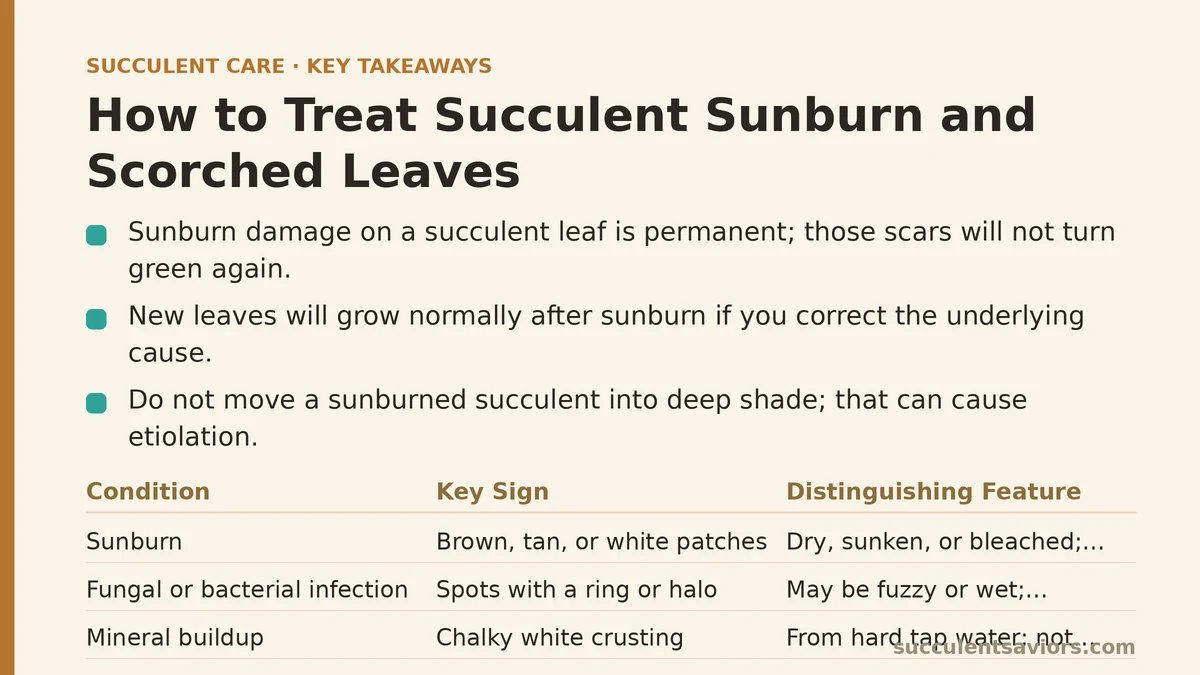
Myth #1: “Sunburned Spots Will Heal and Turn Green Again”
This is the myth that causes the most anxiety, because people keep waiting for damage to fade and feel like failures when it doesn’t.
The Reality: Sunburn damage is permanent on the leaf it appears on. Those brown, tan, or white patches are dead or dying plant tissue, similar to a scar. The cells have been damaged by UV exposure and heat beyond what the plant’s natural defenses could handle, and no amount of adjusted watering or fertilizing will restore that tissue to green. The good news is that the plant itself is not permanently damaged. Succulents are remarkably resilient, and new leaves that grow after the burn will be completely normal, assuming the underlying cause is corrected.
So the goal isn’t to “fix” the burned leaf. The goal is to stop the burning from continuing and let the plant grow its way out of the problem over the following weeks and months.
Myth #2: “Any Discolored Spot on a Succulent Is Sunburn”
Because sunburn is so widely discussed, it has become the default explanation for almost any blemish, and that’s led to a lot of misdiagnosed plants.
The Reality: Several other issues produce spots or discoloration that look similar at a glance, and treating them as sunburn means missing the actual cause. Fungal or bacterial infections often cause spots with a distinct ring or halo, sometimes with a slightly fuzzy or wet texture, and they tend to spread to nearby leaves over time rather than staying isolated to the sun-facing side. Mineral buildup from hard tap water can leave chalky white crusting, which is different from the crisp, papery texture of a sunburn scar. Pest damage, particularly from mites, often shows up as stippled or scarred patches that are textured rather than flat and tend to appear regardless of which side of the plant faces the light.
True sunburn has a few reliable tells: it appears almost exclusively on the side of the plant that faces the light source, it develops within days of a light change (a new window, a move outdoors, a heat wave), and the tissue looks dry, sunken, or bleached rather than soft or fuzzy. If your discoloration doesn’t match that pattern, look elsewhere before you assume sun is the culprit.
Myth #3: “Move It to Shade Immediately and It Will Recover Faster”
The instinct to yank a burned plant into deep shade feels protective, but it usually backfires.
The Reality: Sudden, drastic changes in light are exactly what caused the problem in the first place, and swinging to the opposite extreme creates a new one. Move a sunburned succulent into low light and it will stop producing new growth efficiently, or worse, it will begin etiolating, stretching toward whatever light it can find while the burned leaves remain exactly as scarred as before. You’ve traded one problem for another without actually solving anything.
The better move is a moderate step down in intensity, not a leap into darkness. If the plant was in direct afternoon sun on a south-facing sill, move it to bright, indirect light, or direct morning sun only, rather than to a dim corner. This keeps the plant photosynthesizing well enough to produce healthy new growth while giving the damaged tissue no further exposure to compound the injury.
Myth #4: “You Should Cut Off Sunburned Leaves Right Away”
Trimming feels productive, and there’s a persistent idea that removing damaged tissue speeds up recovery.
The Reality: Even sunburned leaves are still capable of photosynthesis, and succulents rely heavily on stored energy in their leaves to fuel new growth. Removing scarred but otherwise intact leaves prematurely can slow the plant’s recovery by cutting off a resource it needs. The exception is when a leaf has burned so severely that it becomes mushy, translucent, or clearly dying rather than simply scarred and dry. In that case, removing it prevents it from becoming an entry point for rot or pests.
A reasonable rule: if the leaf is scarred but firm, leave it in place and let it do its job until it naturally shrivels or is pushed out by new growth. If it’s soft, wet, or collapsing, trim it with a clean tool.
Myth #5: “Sunburn Only Happens Outdoors in Summer”
Because sunburn gets associated with vacation plants left on a patio in July, many growers assume their indoor collection is safe year-round.
The Reality: Sunburn is caused by a mismatch between light intensity and the plant’s acclimation, not by a specific season or location. Indoor plants can burn when moved too close to an unobstructed south or west-facing window, especially in spring when the sun angle shifts and light that was previously filtered by bare tree branches suddenly hits at full strength. Magnifying effects from window glass can concentrate light onto a small area of a leaf, causing a burn spot smaller and more concentrated than what typically happens outdoors. Even a plant that’s lived happily in the same spot for a year can burn if a nearby tree is cut down, a curtain is removed, or reflective surfaces nearby (light-colored walls, mirrors, glossy furniture) start bouncing extra light onto it.
The lesson is that any sudden increase in light intensity, from any source, indoors or out, deserves the same cautious approach.
Getting the Recovery and Prevention Right
Once you’ve confirmed sunburn and ruled out the lookalikes, the actual treatment is refreshingly low-effort:
- Identify and moderate the light source. Move the plant to a slightly less intense spot, or add a sheer curtain to diffuse direct rays through a window.
- Resist trimming intact leaves. Only remove tissue that has gone soft or mushy.
- Maintain normal watering. Sunburn stress doesn’t change the plant’s water needs; stick to your soak-and-dry schedule.
- Wait for new growth. New leaves will emerge undamaged as long as the light problem has been corrected.
For preventing a repeat, acclimation is everything. Any time you’re increasing a succulent’s light exposure, whether that’s moving it outdoors for summer or relocating it to a brighter windowsill, do it gradually. An hour or two of direct sun for the first few days, increasing incrementally over one to two weeks, gives the plant’s tissues time to build up protective pigments and thicken slightly in response. Skipping this step and jumping straight to eight hours of full sun is the single most common cause of sunburn I see.
Quick Reference: Sunburn Myths vs. Reality
| Myth | Reality |
|---|---|
| Sunburn scars will fade and turn green again | The damage is permanent on that leaf; only new growth will be unmarked |
| Any spot on a succulent is sunburn | Fungal spots, mineral crust, and pest damage all mimic it — check location and texture |
| Moving to deep shade speeds recovery | A moderate reduction in light is better than an extreme swing |
| Burned leaves should be cut off immediately | Leave firm, scarred leaves in place; only remove soft or mushy ones |
| Sunburn only happens outdoors in summer | Indoor plants can burn too, especially near unobstructed or seasonally changing windows |
A Note on Patience
The hardest part of treating sunburn isn’t any specific technique — it’s accepting that the marked leaves won’t be undone. Growers often hold onto a badly scarred plant for months, convinced that one more adjustment will erase the damage, when the real solution is simply to correct the light and let the plant do what it does naturally: grow forward. Give it time, moderate the light source, and within a season or two, the scarred leaves will be old news, pushed down and out by growth that never saw the problem in the first place.
Has your succulent’s sunburn ever been misdiagnosed as something else, or did you catch the light problem before real damage set in?
Related guides: Common Mistakes Diagnosing Succulent Sunburn vs Overwatering Symptoms, How to Fix Cracked or Split Succulent Leaves, and Succulent Leaves Turning Translucent and Mushy: 5 Causes Ranked From Most to Least Likely.