Most beginners believe succulent care boils down to a simple rule: water once a week, or once every two weeks, and you’re done. That single belief kills more succulents than any pest, any disease, or any amount of neglect. The truth is, no calendar-based schedule works, because your plant doesn’t know what day it is. It only knows whether its roots are sitting in moisture or bone-dry soil. Watering on a fixed schedule ignores every variable that determines when your plant needs a drink—pot size, soil mix, humidity, light exposure, and the season outside your window.
Here’s the better way to think about it: you’re not building a schedule. You’re building a checklist you run through before every single watering. Master that checklist, and you’ll never drown another succulent again.
The Setup That Changed Everything
Let’s walk through this with a real scenario. A friend bought her first Echeveria—a gorgeous, dusty-blue rosette about the size of a teacup. She placed it on her kitchen windowsill, bought a nice terracotta pot with drainage holes, and filled it with regular potting soil she had left over from her tomatoes. She read online that succulents need water every 10 days. So she set a reminder on her phone.
Three weeks later, the bottom leaves had turned translucent and mushy. The stem felt soft near the soil line. She was baffled. She’d followed the schedule perfectly.
Here’s what the schedule didn’t tell her: that regular potting soil stays wet for a week or more in a cool kitchen, especially in a glazed pot—but she’d used terracotta, which wicks moisture away faster. The windowsill got decent morning sun, but winter light was weak, slowing evaporation further. Every one of those variables changed how quickly the soil dried. Her “water every 10 days” rule was calibrated for a completely different environment.
The fix started with the foundation, not the frequency.
Step 1: Fix the Soil Before You Fix the Schedule
Watering is only as good as the soil you’re watering into. Dense, moisture-retentive potting mix is the number one accomplice in succulent murder. It holds water against the roots for days too long, and by the time the top looks dry, the bottom is still a swamp.
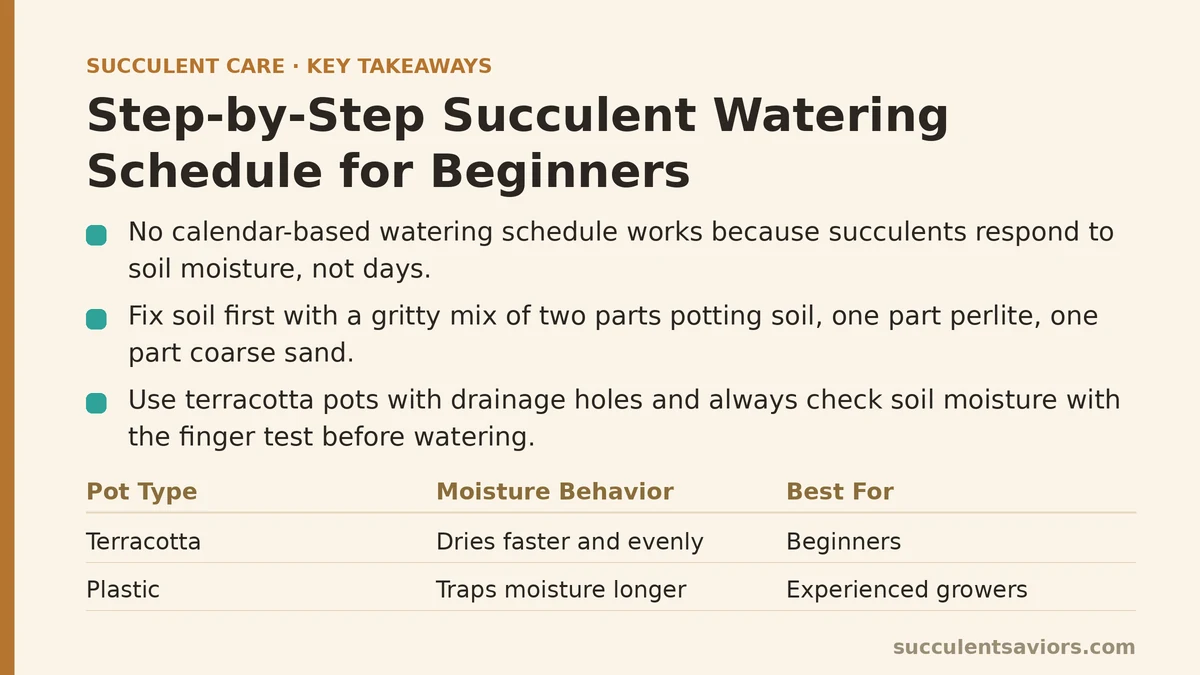
The beginner-friendly recipe: two parts regular potting soil, one part perlite, one part coarse sand. Mix it thoroughly. You’re looking for a texture that feels gritty and drains instantly. When you squeeze a handful, it should fall apart quickly, not clump into a muddy ball.
If you’re using a commercial “cactus and succulent” mix, read the label. Many of them are still too heavy. Add perlite anyway—it’s cheap insurance.
Step 2: Choose Your Pot With Watering in Mind
Terracotta is the beginner’s best friend. Its porous walls let moisture escape from the sides, not just the bottom, which means the soil dries out faster and more evenly. Plastic pots trap moisture longer—useful for an experienced grower who knows exactly what they’re doing, dangerous for someone still learning the signals.
Drainage holes are non-negotiable. If a pot has no holes, it’s not a pot—it’s a water trap. If you love a decorative pot without drainage, use it as a cachepot: plant your succulent in a plain terracotta pot, then slide that inside the pretty one. When you water, take the inner pot out, let it drain completely, then put it back.
Step 3: Learn the Finger Test, and Trust It Over Any App
Forget the calendar. Before you even consider watering, push your index finger two inches into the soil—down past the top layer. If you feel any moisture at all, even a slight coolness, your plant doesn’t need water yet. If the soil is dry all the way down, and I mean completely dry, you’re cleared to water.
This test takes three seconds and tells you more than any smartphone app can. Apps guess based on averages. Your finger reads this exact pot, this exact soil, this exact light, on this exact day.
You’ll feel the difference quickly. Moist soil feels cool and clinging. Dry soil feels warm and crumbly. Within a few weeks, you’ll know without even thinking about it.
Step 4: Watch the Leaves for Their Own Signals
Your succulent is not passive. It tells you when it’s thirsty, if you know what to look for. Plump, firm leaves that feel slightly squishy like a ripe grape mean the plant is hydrated. When the leaves start to feel softer, slightly deflated, and maybe show faint wrinkles or a little give when you pinch them gently, that’s the plant saying it’s ready for a drink.
This is the secret that experienced growers rely on. The leaves are a living moisture meter, and they’re always accurate.
There’s a catch, though. A thirsty succulent looks similar to an overwatered one at first glance—both have soft, wrinkled leaves. The difference is in the details. Thirsty leaves feel dry and papery to the touch, and they wrinkle from the bottom up. Overwatered leaves feel mushy and translucent, often yellowing or bursting, and the damage usually starts near the soil line. If you’re unsure, check the soil first. If the soil is bone dry, it’s thirst. If the soil is damp, step away from the watering can.
Step 5: Water Deeply, Then Walk Away
When the soil is bone dry and the leaves show signs of thirst, water thoroughly. The goal is to saturate the entire root ball, not just dampen the top inch. Pour slowly and evenly over the soil surface until water runs freely out the drainage holes. Wait a few minutes, then do it again—sometimes a dry root ball repels water on the first pass, and a second pour ensures the whole thing gets soaked.
For very dry, compacted soil, bottom watering works even better. Place the pot in a tray or bowl of water and let it soak upward through the drainage holes for 15 to 30 minutes. You’ll see the soil surface darken when it’s fully saturated. This method guarantees even moisture distribution and keeps the top of the soil—and any leaves resting on it—dry.
After that, don’t even think about watering again for a week, maybe two, maybe three. The plant will tell you. This is the moment where most beginners undo their progress: they water, see the soil look dry a few days later, and water again out of anxiety. That’s how you get root rot. Dry soil on top is fine. Dry soil all the way down is the only signal that matters.
Step 6: Track the Drying Time, Not the Watering Date
Here’s the mental shift that saves a collection: instead of tracking when you watered last, track how long it took the soil to dry completely. That number—your soil’s dry-down time—is the variable that changes with the seasons.
In summer, with bright light and warm temperatures, that might be five days. In winter, in a cool room with weak light, it might stretch to three weeks. If your plant sits near a heater vent in winter, it might dry in a week. If it’s in a humid bathroom, it could take a month.
Once you know a pot’s typical dry-down time, you’ll develop a rough rhythm: check the soil around day four or five, check the leaves, and let the plant lead. In summer you might water every week. In winter, maybe once a month. The plant decides. You’re just paying attention.
The Case Study, Conclusion
My friend repotted her Echeveria in the gritty mix, moved it to a slightly larger terracotta pot, and put it back on the same windowsill. She threw away her phone reminder. For the next month, she checked the soil with her finger every few days, watched the bottom leaves firm up, and waited.
The first dry-down took twelve days. She watered deeply, bottom-up, for twenty minutes. The next dry-down took nine days—the roots had filled out more. That pattern repeated through spring, with the intervals gradually shortening as light increased. By June she was watering every four or five days, and her rosette had doubled in size, new leaves forming tight and compact.
She didn’t find a perfect schedule. She found something better: a method she could adjust, season after season, pot after pot, plant after plant.
A Quick Checklist to Copy
Keep this somewhere you’ll see it before you reach for the watering can:
| Check | Yes | No |
|---|---|---|
| Soil is dry at least 2 inches down? | 🌵 Water | ⏳ Wait |
| Leaves feel slightly soft or wrinkled? | ✅ Confirm | ❌ Wait |
| Pot has drainage and soil is gritty? | 🌊 Water deeply | 🛠️ Fix first |
| Time since last watering is longer than last dry-down? | 🎯 You’re ready | ⏳ Wait longer |
The One Mistake That Lingers
Even with all this, you might still lose a plant. It happens. The most common beginner failure isn’t watering too much—it’s watering too shallow. A quick splash of water on the top inch of soil encourages roots to stay near the surface, where they’re more vulnerable to drying out and to temperature swings. They never grow deep enough to support the plant properly.
Deep watering fixes this. When you saturate the entire pot, you train the roots to chase moisture downward, building a stronger, more resilient root system. Every deep watering makes the next one easier.
So forget the schedule. Forget the reminder app. Your succulent doesn’t care what day of the week it is—it cares whether its roots are getting a deep drink after a complete dry-out. Check the soil with your finger, read the leaves, water deeply, and let the plant set the rhythm. What has your succulent’s leaves been telling you lately—firm and plump, or soft enough to need a drink?
Related guides: How to Repot a Succulent: Step-by-Step Beginner Guide, Succulent Pest Treatment with Neem Oil: A Step-by-Step Beginner Guide, and Succulent Watering Mistakes: A Troubleshooting Chart for Common Problems.