You’re looking at your echeveria and you see it: a scattering of dark, sunken spots across the lower leaves. Your first instinct is panic. Your second instinct is to reach for whatever spray you have under the sink. Stop.
Black spots on succulent leaves fall into two main camps, and they demand completely opposite responses. One type—sunburn—is harmless, cosmetic damage that the plant will outgrow on its own. The other—fungal leaf spot—is contagious, progressive, and will spread to your entire collection if you don’t act quickly. The difference between them comes down to where the spots are, how they feel, and how fast they change.
Here are the questions you’re probably asking right now, in the order you’re probably asking them.
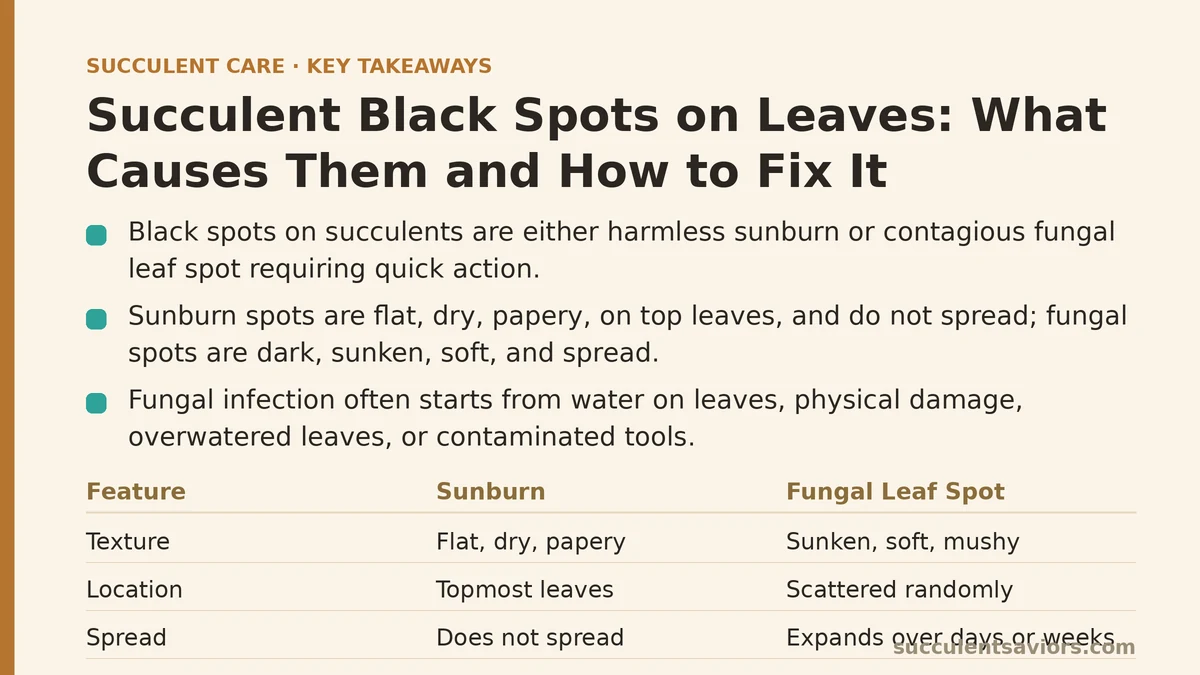
Is This Sunburn or a Fungal Infection?
The short answer: Look at the pattern, the texture, and the timing.
Sunburn spots are flat, dry, and papery. They appear on the topmost leaves—the ones facing the light source—and they look like pale, beige, or light-brown patches that sometimes darken to a muted charcoal over time. The tissue feels crisp, like dry paper, and the spots don’t grow once they appear. They’re a scar, not a disease. This happens when you move a plant from indoors to full afternoon sun without a transition period, or when a water droplet sits on a leaf during intense light and acts as a magnifying lens.
Fungal spots are different. They’re dark brown or true black, with a slightly sunken, water-soaked look. The leaf tissue around them feels soft, almost mushy, when you press gently. The spots are scattered randomly across the leaf surface, not clustered toward the light, and they expand over days or weeks. Black spots that spread are the ones that need swift action.
When this matters most: In spring and early summer, when growers move plants outside, sunburn cases spike. In humid, overcast stretches—especially in late winter or during rainy seasons—fungal issues spike instead.
How Did My Succulent Get a Fungal Infection?
Fungal spores are everywhere. They live in the soil, on your hands, on the air itself. A healthy succulent with intact epidermal tissue and dry leaves can usually resist them. The infection takes hold when you accidentally hand the fungus an entry point.
The most common pathway is water on the leaves over a long period. If you top-water in the evening, and the plant sits in a cool, low-airflow spot with droplets trapped in the leaf rosette, you’ve created a fungal incubator. Morning dew, steam from a nearby bathroom, or a humidifier blowing directly on your plants does the same thing.
Other entry points include:
- Physical damage: Small nicks from repotting, from being bumped, or from a pest biting the leaf tissue.
- Soft, overwatered leaves: If roots are waterlogged, the leaves swell and burst at the cellular level, providing fungus an easy entrance.
- Contaminated tools: Using the same scissors or pruning knife on an infected plant and then a healthy one without wiping the blade with alcohol in between.
Which Succulents Are Most Vulnerable?
The short answer: Tight-rosette species with thin, densely packed leaves are the most susceptible, because water collects in those leaf joints and stays there.
Echeveria, Graptoveria, Sempervivum, and the more delicate Sedum species top that list. Their leaves overlap in layers that trap moisture near the stem. Aeonium and Haworthia, with their more open growth patterns, fare better, though they aren’t immune.
If you grow any of the tight-rosette types, consider your watering method carefully. This is where the “when” matters more than the “how.” Water in the morning, early enough that any residual moisture on the leaves evaporates before evening. A gentle spout at the soil surface, or better yet a bottom-watering tray, keeps the rosette dry through the night.
What Should I Do the Moment I Spot Black Leaf Spots?
The short answer: Assess, isolate, remove the infected leaves, and keep the plant dry while it recovers.
Here’s the hands-on sequence that works in practice:
- Inspect the pattern once more. If you’re certain it’s sunburn, move the plant to slightly lower light and let it grow out. The damaged leaves will drop on their own as new growth fills in. No treatment needed.
- If it’s fungal, quarantine the plant. Move it to a separate room or shelf, away from healthy succulents. Fungal spores transfer through contact, through water splash, and through shared air circulation in a small space.
- Remove every infected leaf. Use sterile scissors or clean fingers to twist the leaf off at the base. Do not leave a partial leaf stub. Place the removed leaves in a sealed bag and discard them—do not compost them.
- Check the leaf joints for any remaining black tissue. If the infection has spread to the stem, you’ll see dark streaks traveling up the base. That’s a more serious situation, addressed below.
- Let the plant dry completely. Do not water for at least a week. This gives the cut wounds on the stem time to callus over and the fungal activity to die back. Leave the plant in a bright spot with good airflow.
For the remaining healthy leaves, you can apply a sulfur-based fungicide powder lightly over the surface. This isn’t a rescue treatment—it’s a preventative layer that keeps spores from germinating on healthy tissue. You can find it at any garden center.
What If the Fungus Has Reached the Stem or the Roots?
The short answer: If you see dark, sunken tissue at the base of the stem, or if the plant wobbles firmly in its pot, the fungus has moved below the soil line. This is the version of black spot that kills succulents.
The stem tissue rots, the vascular system collapses, and the plant can’t transport water or nutrients anymore. It looks, from the outside, like a succulent that suddenly stops drinking, with lower leaves that go soft and yellow before drying up.
Here’s the rescue protocol:
- Unpot the plant immediately. Shake off all soil so you can see every inch of the stem and roots.
- Inspect the roots. Healthy roots are white or light tan and firm. Rotted roots are dark, mushy, and may pull away from the central root core with light pressure.
- Cut away everything soft. Using sterile scissors, trim the stem above the rot. Cut into healthy tissue until you see a clean, pale-green cross-section with no dark streaks. If the infection reaches the very center of the stem, keep cutting until the entire dark core is gone.
- Let the cutting callus for three to five days. Set it on a dry paper towel in a shaded spot. A thick callus over the wound is essential—it’s the plant’s only defense against re-infection after you repot it.
- Repot in fresh, bone-dry, gritty soil. Skip watering for the first week. Then begin a reduced watering schedule, and expect root formation over the next month or two.
This is not a guaranteed fix, but for a plant with a rot-free top rosette, it gives you a solid shot at a saving a cutting rather than losing the whole plant.
Can I Propagate the Healthy Leaves From an Infected Plant?
The short answer: Yes, but only if the mother leaf itself shows zero black spots.
Fungal spores are microscopic, and a leaf that looks clean might still carry dormant spores on its surface. The safest approach is a sanitizing rinse: hold the leaf under running water for a few seconds, then dip it in a 70% isopropyl alcohol solution for five seconds, then let it dry completely before placing it on propagation soil. Does it guarantee a spore-free future? Nothing does. But it reduces the odds substantially.
Skip propagation from anything near the infected area on the stem. Only take leaves from the outermost, healthiest rings of the rosette, and use a leaf that hasn’t touched soil or another damaged leaf.
How Do I Prevent Black Spots From Coming Back?
The short answer: Change three habits—watering method, airflow, and light transitions—and you’ll eliminate the conditions that allow fungal spores to take hold in the first place.
Watering method. Stop showering your succulents from above. Use a narrow-spout watering can that reaches the soil surface without wetting the leaves. Bottom watering—placing the pot in a tray of water for 15–20 minutes—keeps the rosette bone-dry and is the single most effective shift for growers struggling with recurring black spots.
Airflow. Fungus thrives in stagnant, damp pockets. A small clip-on fan run on low for a few hours in the morning dries dew and residual moisture from leaf surfaces, especially in indoor settings where natural airflow is limited. Dense trays of plants packed together also trap humidity—space pots out so air can move between them.
Light transitions. When you move plants outdoors in spring or increase indoor light intensity, do it in stages. One week of morning-only sun, then a second week of partial afternoon sun, before full exposure. This prevents sunburn, which, even though it’s cosmetic damage, creates those entry points for fungus to exploit later.
Quick Reference: Black Spot Diagnosis
| Spot Type | Appearance | Location | Spreads? | Response |
|---|---|---|---|---|
| Sunburn | Flat, dry, pale to dark beige | Topmost leaves facing light | No | Move to lower light; wait for new growth |
| Fungal leaf spot | Sunken, dark brown to black, soft | Scattered randomly, often lower leaves | Yes, over days/weeks | Remove leaves, quarantine, keep dry |
| Stem rot (advanced fungus) | Dark streaks at stem base, plant wobbles | Base of stem, below soil line | Yes, kills plant | Unpot, cut rot, callus, repot |
Holding the two types of black spots in your mind changes how you react. Sunburn spurs you to adjust light. Fungal spots demand you reach for sterile scissors, not worry. It takes one careful look at the pattern—flat versus sunken, clustered versus scattered, static versus spreading—to know which one you’re holding. Have you caught black spots on your succulents at the sunburn stage, or did you only notice once they’d spread?
Related guides: Succulent Leaves Turning Translucent and Mushy: 5 Causes Ranked From Most to Least Likely, Why Succulent Leaves Are Falling Off and What to Do, and How to Fix Cracked or Split Succulent Leaves.