Say you are trying to keep a small tray of succulents alive on the reception desk. It looked perfect the day you set it up—tight rosettes, tidy spacing, maybe a little sign that reads “Welcome.” Three weeks later the echeveria is stretching toward the ceiling on a pale stalk, the jade plant has dropped two leaves onto the keyboard, and someone has already watered it “to help” without asking. This is the standard arc of the front-desk succulent, and it fails for reasons that are almost never about the plant being difficult.
Office reception areas are one of the hardest environments for succulents, but not because the plants are fragile. It is because the conditions are the opposite of what most succulent advice assumes. Below are the myths that sink most front-desk displays, paired with what is really going on and what to do instead.
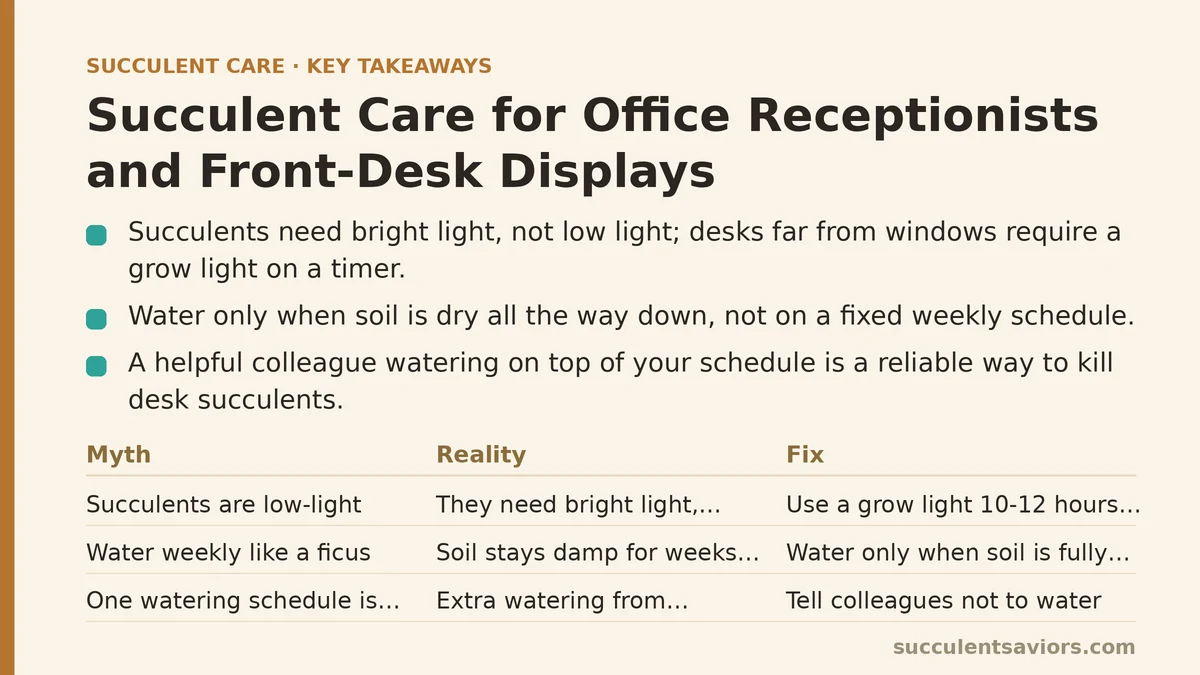
Myth #1: “Succulents Are Low-Light Plants, So a Reception Desk Is Perfect”
This is the single most common belief that leads to leggy, pale, dying desk displays. Succulents are commonly marketed as low-maintenance plants for offices, and that marketing has quietly merged “low maintenance” with “low light.” They are not the same thing.
The reality: Most popular desk succulents—echeveria, sedum, haworthia variants to a lesser degree, and jade—evolved in bright, exposed conditions. What they tolerate is infrequent watering, not darkness. A reception desk that sits more than a few feet from a window, or that relies on overhead fluorescents, typically delivers a fraction of the light these plants need to hold their shape. The plant does not die immediately. It etiolates: it stretches, the leaves space out along a lengthening stem, and the color fades from deep green to a washed-out yellow-green. Overhead office lighting runs roughly 300–500 lux at desk height in most buildings; a succulent generally wants several times that from a real light source.
What to do instead: Be honest about how much light the desk gets before you buy anything. Stand at the desk at midday and look for a spot that feels bright enough to read without squinting—if there is no window within a few feet, a small clip-on or desk grow light is not optional, it is the whole game. Set it on a timer for 10 to 12 hours a day. Fluorescent and LED office fixtures do not substitute, because the distance between the fixture and the desk is usually too great.
Myth #2: “Water It Once a Week, Same as the Office Ficus”
Reception desks tend to develop a watering culture—someone waters on Fridays, or the plant gets a splash whenever someone thinks of it. That rhythm comes from houseplant habits and it is wrong for succulents in an office.
The reality: Indoors, with low light and often dry HVAC air, a succulent’s soil can stay damp for weeks. Weekly watering in that environment is a slow drowning. The roots sit in moisture, the lower stem goes soft and translucent, and by the time you notice, the rot has moved upward. A second, quieter problem is the “helpful colleague” who waters your plant on top of your schedule. Two people watering the same dry-tolerant plant is one of the most reliable ways to kill it.
What to do instead: Switch from a calendar to a check. Push a finger about an inch into the soil—if it is even slightly cool or clings to your skin, wait. Water thoroughly only when the soil is dry all the way down, then let it drain fully and tip out any standing water in the saucer. In practice, a small desk succulent in moderate office light often needs water every 10 to 21 days, and less in winter. If coworkers keep watering it, a small “Please do not water—I have a schedule” card tucked into the pot solves more problems than any soil amendment.
Myth #3: “Terrariums and Glass Jars Look Best on a Front Desk”
Glass terrariums and open jars photograph beautifully and fit the clean, modern reception look. They are also the container type most likely to kill a succulent on a desk.
The reality: Glass holds moisture. A closed or narrow-necked terrarium traps humidity around the leaves and keeps the soil from drying out, which is the opposite of what a succulent needs. Even an open glass bowl has no drainage unless you drill it, so any excess water pools at the bottom and slowly rots the roots. The display looks fine for weeks—and then the whole arrangement collapses at once.
What to do instead: Choose containers with a drainage hole and, ideally, an unglazed or terracotta surface that lets the soil breathe. If you love the glass look, use a glass vessel as a cachepot: keep the plant in a small plastic or terracotta pot with drainage, and set that inside the glass, lifting it out to water and drain. For a formal front-desk tray, shallow ceramic planters with drainage holes work well and still look polished. Add a thin layer of grit or pebbles on the soil surface for a finished look—but do not use a “drainage layer” of rocks at the bottom of a closed container in place of an actual hole; it does not work, it just raises the saturated zone closer to the roots.
Myth #4: “Any Succulent Will Do—Just Pick the Prettiest One”
Retail displays pull you toward the most sculptural, colorful plants: the purple echeveria, the tight green rosette, the red-tipped sedum. On a low-light reception desk, those are often the first to fail.
The reality: Succulents vary widely in light tolerance. Echeveria and most colorful rosette types need strong light to keep their color and compact shape and will stretch fastest in dim offices. The tough, forgiving choices for a desk are different plants entirely—snake plant, ZZ plant, haworthia, and certain aloes handle low light and infrequent watering far better than a rainbow of rosettes ever will. If you want color, be prepared to run a grow light.
What to do instead: Match the plant to the light you have, not to the plant you want. For a bright desk near a window, echeveria, jade, and sedum are fair game. For a dim interior desk, build around haworthia, snake plant, and ZZ plant, then add one small grow light if you want to include a rosette. A mixed display is easier to maintain when all its members share similar light and water needs, so group low-light plants together rather than mixing a high-light echeveria in with the tolerant species.
Myth #5: “A Fixed Watering Day Keeps the Display Consistent”
A regular watering day feels professional and easy to hand off to whoever covers the desk. It is also the reason most displays decline in a slow, invisible way.
The reality: A plant’s water use changes with the season, the light level, and the indoor temperature. A schedule that is right in July will be too much in January, when growth slows and the soil dries more slowly. Following the calendar instead of the soil means overwatering in winter and underwatering in a bright summer window.
What to do instead: Keep the schedule, but redefine it as a check day rather than a water day. Once a week, walk the display, push a finger into each pot, and water only the ones that are dry. Rotate the pots a quarter turn so growth stays even. Every two to three months, look at each plant’s underside leaves and the soil surface for the early signs of trouble—fine webbing, tiny white flecks, or a stem that feels soft at the base. Catching a problem while it is small is a five-minute fix.
Quick Reference: Myth Versus Reality
| The Common Belief | What Really Happens | The Reliable Approach |
|---|---|---|
| Succulents are low-light office plants | Most stretch and fade in dim reception areas | Add a grow light, or choose haworthia, snake plant, or ZZ plant |
| Water once a week on a fixed day | Soil stays damp too long; roots rot | Water only when the soil is dry all the way down |
| Glass terrariums look best | Trapped moisture and no drainage rot the roots | Use a pot with drainage; use glass only as a cachepot |
| Pick the prettiest rosette | High-light plants fail on dim desks | Match the plant to the light the desk gets |
| A set watering day adds consistency | Water needs shift with season and light | Keep a weekly check day; water only the dry pots |
The thread running through all five myths is the same: a front-desk display fails when its care is built around appearance and convenience instead of the plant’s real conditions. Light and drainage drive almost everything. Get those two right, add a light if the desk has none, and the rest is a weekly finger-in-the-soil check that takes about two minutes. A reception display does not need to be elaborate to stay healthy—it needs to be honest about where it is sitting.
Which of these has tripped up your desk display—a terrarium that looked too good to pass up, or a watering day that quietly turned into overwatering?
Related guides: Succulent Care for Office Desks and Corporate Workspaces, Succulent Care Guide for Frequent Travelers and Business Trips, and How to Care for Succulents While Traveling: A Step-by-Step Prep Guide.