The most common misconception about mealybug treatment is that one product is the “right” one and the others are inferior. In practice, rubbing alcohol, neem oil, and insecticidal soap are not competing brands of the same thing—they work through completely different mechanisms, at different life stages, and with different risks to your succulent. Choosing between them is a matter of matching the tool to the situation in front of you, not picking a favorite.
This guide walks through the decision and application process step by step, so you can stop second-guessing the bottle on the shelf and start treating with a plan.
Step 1: Confirm It Is Mealybugs Before You Treat Anything
Before comparing products, make sure you are targeting the right pest. Mealybugs show up as small, soft, white cottony clusters tucked into leaf axils, along stem joints, and around the crown. You may also see sticky honeydew residue, sooty black mold growing on that residue, or tiny white crawlers moving when you disturb a cluster.
A few lookalikes to rule out:
- Root mealybugs live in the soil and appear as white waxy fuzz around the root ball when you unpot—foliar sprays will not reach them.
- Spider mites produce fine webbing and pale stippling rather than cottony clusters, and they need a different approach entirely.
- Mineral deposits or perlite dust can look white and fuzzy at first glance but do not smear when touched.
Look closely with a phone camera zoom or a magnifying glass. Treating the wrong pest with the wrong product is the fastest way to waste a month.
Step 2: Understand How Each Treatment Works
Each of the three options attacks mealybugs differently. Knowing the mechanism tells you when each one fits.
Rubbing alcohol (70% isopropyl) dissolves the waxy coating on mealybug bodies and kills adults and nymphs on contact. It evaporates quickly, leaving no residue. It has no residual effect—once it dries, it is done. Eggs inside waxy sacs are largely protected.
Neem oil works as a suffocant and anti-feedant. It coats insects and eggs, blocking their breathing pores, and it interferes with feeding and molting. It leaves a light residue that offers short-term protection but breaks down in sunlight within hours to a couple of days. It can also leave an oily film on leaves if over-applied.
Insecticidal soap (potassium salts of fatty acids) disrupts cell membranes on contact, killing soft-bodied insects quickly. Like alcohol, it has no residual activity once dry. It is gentle on most succulents when mixed and applied correctly but can burn foliage if applied in strong sun or at too high a concentration.
Step 3: Match the Treatment to Your Situation
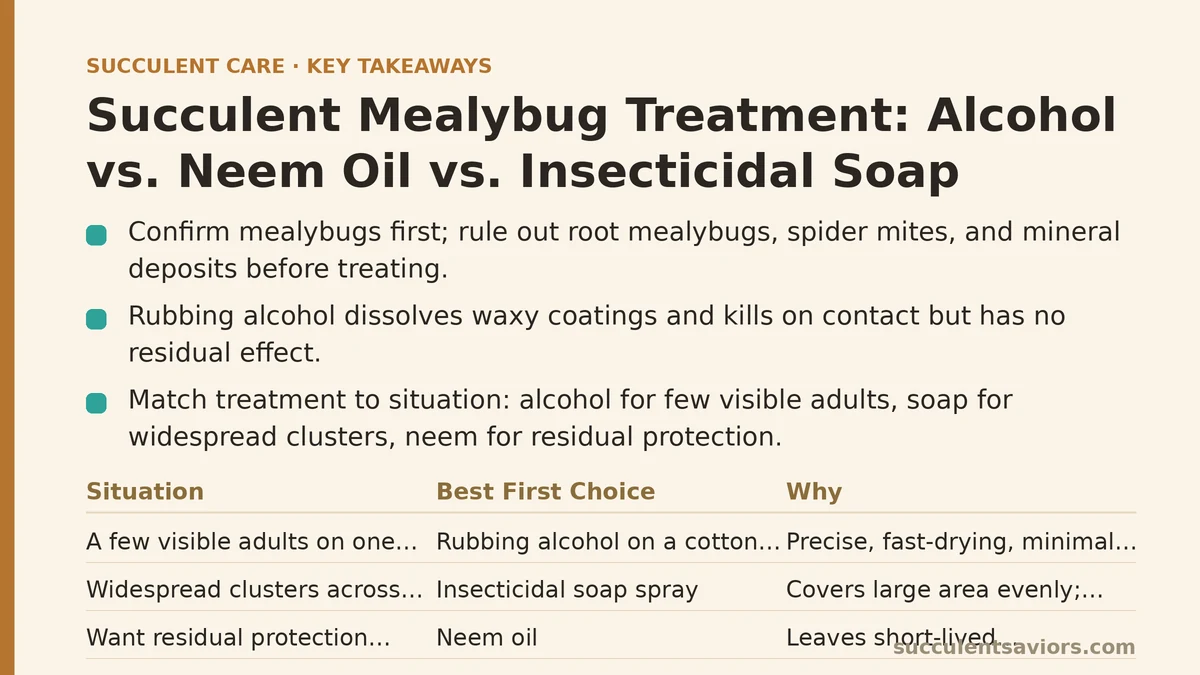
Use this table to narrow down which option fits your plant, your season, and your comfort level.
| Situation | Best First Choice | Why |
|---|---|---|
| A few visible adults on a single plant, indoor, cool evening | Rubbing alcohol on a cotton swab | Precise, fast-drying, minimal risk to leaf coating |
| Widespread clusters across multiple leaves | Insecticidal soap spray | Covers large surface area evenly; kills on contact |
| You want some residual protection between treatments | Neem oil | Leaves a short-lived protective film and disrupts the life cycle |
| Plant is in bright direct sun or a hot greenhouse | Rubbing alcohol or evening soap application | Oils and soaps can burn foliage in heat and strong light |
| Fuzzy, waxy leaf coatings (e.g., some Echeveria, Kalanchoe) | Rubbing alcohol spot treatment | Soaps and oils can strip the farina and leave permanent marks |
| You are also seeing eggs and want to interrupt hatching | Neem oil rotated with soap | Neem coats egg sacs; soap handles newly hatched crawlers |
| You are treating a large collection | Soap for the bulk pass, alcohol for spot fixes | Soap is economical and fast; alcohol targets stragglers |
Step 4: Apply Each Treatment Correctly
Application errors cause more damage than the mealybugs in many cases. Here is how to use each product without hurting the plant.
Rubbing alcohol:
- Dip a cotton swab in 70% isopropyl alcohol and dab directly onto each visible mealybug. Watch the white fuzz dissolve.
- For larger areas, use a spray bottle of 70% alcohol, but test on a small leaf first—some thin-leaved succulents show spotting.
- Apply in the evening or away from direct sun. Alcohol evaporates fast, but wet foliage plus sun can still stress the plant.
- Repeat every 4–5 days for 4–6 weeks to catch newly hatched crawlers.
Neem oil:
- Mix according to the label, typically around 1–2 tablespoons per gallon of water for a maintenance concentration. Never exceed the label rate.
- Add a few drops of mild dish soap as an emulsifier if the product is not pre-mixed.
- Spray thoroughly, including leaf undersides and crevices, in the evening. Neem breaks down in sunlight, so evening application gives it the longest active window.
- Do not apply in temperatures above roughly 85°F (29°C) or in direct sun—oil plus heat plus light is a common cause of leaf burn.
- Reapply every 7 days for 3–4 rounds.
Insecticidal soap:
- Mix at the label rate—usually around 1 tablespoon per quart of water for a spray bottle. Stronger is not better; it burns.
- Spray to the point of runoff, covering every surface, especially leaf undersides and stem joints.
- Apply in the evening or on an overcast day. Soap residue plus bright sun can scorch leaves.
- Repeat every 5–7 days for 3–4 rounds.
Step 5: Plan the Follow-Up That Most Growers Skip
Whichever product you choose, the single biggest reason mealybugs return is a treatment plan that stops after the visible insects disappear. Eggs and hidden nymphs survive the first pass. Build in these habits:
- Continue treatments for 4–6 weeks after the last visible mealybug, even if the plant looks clean.
- Rotate products. Alternate soap and neem, for example, to reduce the chance of resistance building and to hit different life stages.
- Quarantine the plant for at least a month, well away from others. Mealybug crawlers walk between touching pots.
- Inspect weekly with a magnifying glass or phone zoom. Check leaf axils, the crown, and the soil surface. Early detection is a ten-minute fix; a full outbreak is a month-long campaign.
- Watch for root mealybugs if the plant keeps declining despite clean foliage. Unpot and check the root ball if symptoms persist.
Step 6: Know the Trade-Offs Before You Commit
Nothing here is a magic bullet, and honesty about the limits matters more than product loyalty.
- Alcohol is precise and fast but has zero residual effect and misses eggs.
- Neem oil offers some residual protection but carries a real risk of leaf burn on farina-coated succulents and in heat.
- Insecticidal soap is economical and effective on contact but needs thorough coverage and careful dilution.
For most hobbyists, the most reliable routine is a bulk soap spray for wide coverage, alcohol on a swab for stubborn spots, and a neem rotation every other round for residual support—all applied in the evening, all repeated for a full month after the last sighting.
A comparison table and a spray bottle will only take you so far—the real variable is whether you keep going for six weeks after the plant looks clean. Which of the three are you planning to try first, and what made you pick it?
Related guides: Common Mistakes Treating Succulent Pests: Mealybugs & Spider Mites, Succulent Pest Treatment with Neem Oil: A Step-by-Step Beginner Guide, and Common Mistakes When Using Neem Oil on Succulents (And How to Avoid Them).