By the end of this guide, you will be able to look at a damaged succulent, run through a short diagnostic sequence, and decide whether you are dealing with sunburn or a fungal infection—two problems that look similar at a glance but require completely opposite responses. Treat sunburn like a fungus and you may expose a stressed plant to unnecessary moisture. Treat a fungus like sunburn and you may give the infection time to spread through your entire collection.
The two conditions share overlapping symptoms: brown or black patches, discolored tissue, and a plant that looks like it is declining for no clear reason. The differences live in the details—where the damage appears, how the tissue feels, how the edges of the damaged area behave, and how the problem progresses over days and weeks. This step-by-step process walks you through those details in the order that resolves the question fastest.
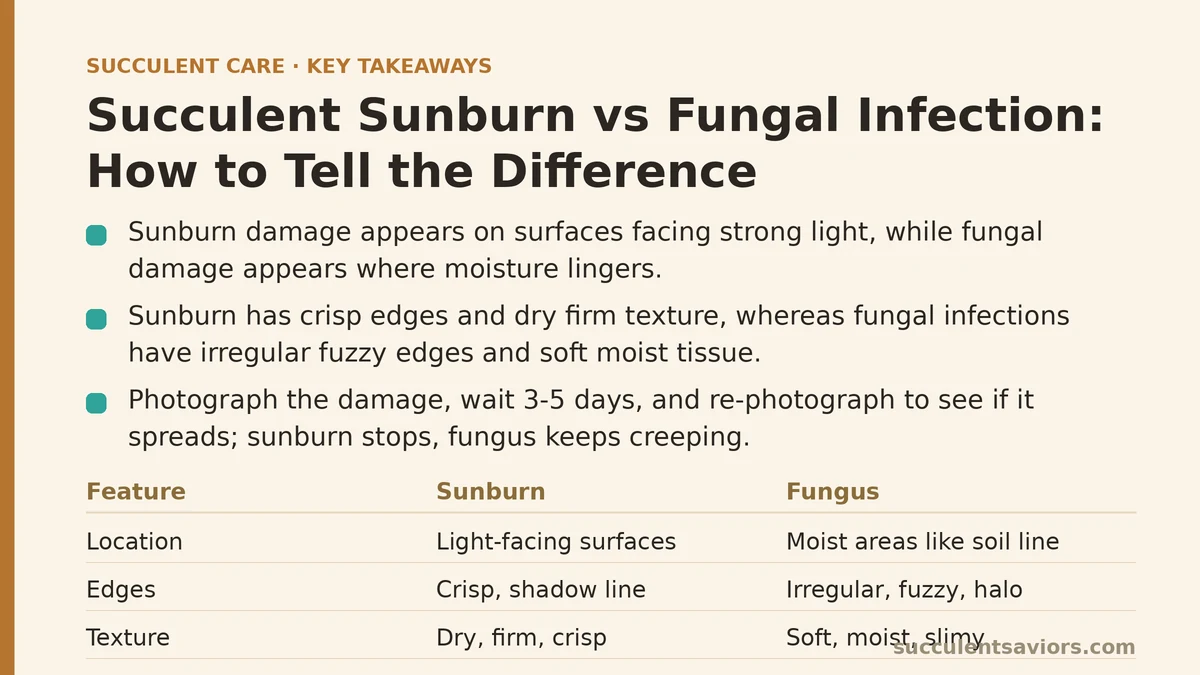
Step 1: Note Where the Damage Is Sitting on the Plant
Location is the single fastest filter. Before you touch anything, look at which parts of the plant are affected.
Sunburn damage concentrates on surfaces that face the strongest light. On a succulent in a south- or west-facing window, that means the side of the plant exposed to the glass, the upper surfaces of the leaves, and any area that was recently moved into brighter conditions. Damage on the shaded side of the plant, or on leaves tucked underneath the canopy, is a poor fit for sunburn.
Fungal damage shows up wherever moisture lingers. That is most often the soil line, the base of the stem, the crown where leaves overlap and trap water, and the undersides of leaves that sit against damp soil. If the damage is at the base of the plant and the top looks fine, your working assumption should be fungal until proven otherwise.
Step 2: Study the Shape and Edge of the Damaged Area
Sunburn creates a fairly predictable shape because it follows the light. The damaged patch usually has a boundary that corresponds to where shade fell across the leaf. You will often see a clean line—sometimes called a shadow line—where the burned tissue ends and healthy tissue begins. That edge is typically crisp, and the transition from brown to green happens over a short distance.
Fungal infections spread outward from a point of origin, so the edges tend to be irregular, fuzzy, or soft-looking. The border between infected and healthy tissue is often blurred, sometimes with a yellow or translucent halo around the dark area. As the infection advances, the dark region may grow in a roughly circular pattern rather than following the contours of light exposure.
A useful check: photograph the damaged area, wait three to five days, and photograph it again from the same angle. Sunburn damage stops expanding once the light stress ends—the burned tissue is dead and the surrounding tissue does not continue to darken. Fungal damage usually keeps creeping outward during that same window, especially in humid conditions.
Step 3: Touch the Tissue (Gently) and Note What You Feel
Texture is where the two problems separate cleanly for most growers.
Sunburned tissue feels dry and firm. It may be slightly crisp at the surface, similar to a callus, and it does not give when you press it lightly. There is no moisture, no slime, and no smell. The dead tissue is essentially scar tissue forming.
Fungal-infected tissue feels soft, squishy, or mushy. When you press a fingertip against it, the surface may give way slightly, and in advanced cases the tissue may collapse or weep fluid. A sour, musty, or earthy smell is a strong indicator of active fungal decay. If you see any of those signs—softness, weeping, or odor—stop and treat it as a fungal problem regardless of location.
Step 4: Check the Surrounding Soil and Environmental History
The plant’s recent history tells you which condition was more likely to develop.
Ask yourself these questions in order:
- Has the plant been moved into stronger light recently? A succulent relocated from a shaded indoors spot to a sunny window, or moved outdoors in late spring without a transition period, is a prime candidate for sunburn.
- Has the soil been consistently wet, or has humidity been high? Fungal problems need moisture to establish. Overwatering, poorly draining soil, crowded pots, and prolonged humid weather all raise the risk.
- Has the plant been watered from above, leaving moisture in the crown? Water sitting in the rosette center or between overlapping leaves is one of the most common entry points for fungal infections.
- Did the damage appear suddenly or gradually? Sunburn can develop within hours to a day of intense exposure. Fungal infections typically develop over several days to a week or more.
If your answers point toward recent light changes, lean toward sunburn. If they point toward prolonged moisture, lean toward fungal infection.
Step 5: Compare Both Possibilities Against the Comparison Table
Use this table to cross-check your observations. Rarely will every row point the same direction, but the majority pattern usually resolves the diagnosis.
| Feature | Sunburn | Fungal Infection |
|---|---|---|
| Typical location | Light-facing surfaces, upper leaves | Soil line, crown, leaf undersides, crowded areas |
| Shape of damage | Crisp edges, often with a shadow line | Irregular, fuzzy edges, sometimes a yellow halo |
| Tissue feel | Dry, firm, callus-like | Soft, mushy, may weep fluid |
| Odor | None | Often sour, musty, or earthy |
| Progression over days | Stops once light stress ends | Continues spreading, especially in humidity |
| Soil condition | Often dry, especially at surface | Often damp, compacted, or slow-draining |
| Recent trigger | Move into brighter light, heat spike | Overwatering, high humidity, overhead watering |
| Response to removing the cause | Stabilizes and scars over | Continues or worsens without treatment |
If the pattern is mixed—some features pointing to sunburn, others to fungus—treat it as a fungal problem until you are certain. Fungal infections progress faster and can kill a plant in days. Sunburn damage, once it has occurred, does not spread further.
Step 6: Choose the Right Response Based on Your Diagnosis
The treatment paths diverge completely, which is why the wrong diagnosis is worse than no diagnosis at all.
If You Concluded Sunburn
Sunburned tissue cannot recover. The cells are dead, and the leaf or patch will remain scarred. The goal is to help the plant adjust and prevent further damage.
- Move the plant out of direct midday sun, but do not push it into deep shade—that causes etiolation. Bright, indirect light is the target.
- If the plant was recently moved into brighter light, reintroduce it gradually. A common approach is to add one hour of direct morning sun per day, increasing weekly until the plant tolerates the full intended exposure.
- Do not water more to “help.” The plant is stressed but not thirsty, and adding water increases the fungal risk.
- Leave the burned tissue in place unless it is soft or weeping. Scarred tissue is ugly but harmless, and removing it can open a wound. If the burned area is extensive and the leaf is clearly useless, wait until the plant is stable before trimming.
If You Concluded Fungal Infection
Fungal problems require prompt, decisive action. Delays of even a few days can allow an infection to reach the roots.
- Isolate the plant immediately. Fungal spores can travel to neighboring pots through splashing water, shared trays, or air movement.
- Remove affected tissue with a sterile blade, cutting back into healthy tissue by a small margin. Sterilize the blade with rubbing alcohol between cuts.
- Improve airflow around the plant. A small fan on low, placed at a distance, helps dry the surface and discourages further fungal growth.
- Reduce watering frequency and ensure the soil dries thoroughly between waterings. Consider repotting into a grittier mix if drainage has been poor.
- Apply a copper-based or sulfur-based fungicide according to the product label if the infection is widespread or has recurred. These are the two most commonly recommended options for succulent fungal issues, and both are widely available. Copper works well for surface-level infections, while sulfur is often used on stem and base rot. Do not combine them unless the label specifically allows it.
- Continue monitoring for at least two weeks after symptoms stop, since fungal spores can remain dormant and re-emerge.
Step 7: Confirm Your Diagnosis After a Few Days
If your initial call was uncertain, the plant’s response over the next five to seven days will often confirm it. Sunburn damage that has been given more shade should look the same or slightly better—the burnt area stays the same size, the surrounding tissue firms up, and no new spots appear. Fungal damage that has been isolated and treated should begin to dry out and stop spreading within a few days. If it continues to spread despite treatment, escalate to a stronger fungicide and check the roots.
The most common mistake in both cases is doing too much. Sunburn rarely needs aggressive intervention beyond light adjustment, and fungal infections need consistent, targeted treatment rather than a scattered approach. Match your effort to the diagnosis, and give the plant time to respond before changing course.
Quick Checklist Before You Treat
Run through this list before you pick up a spray bottle or a pair of scissors:
- Have I confirmed the damage location matches the diagnosis?
- Have I checked tissue texture with a gentle press?
- Have I reviewed the recent watering and light history?
- Have I photographed the area to track change over the next week?
- If fungal, have I isolated the plant from others?
- Have I avoided the urge to water more or move to deep shade as a reflex?
Which of these two problems caught you off guard most recently—a sudden brown patch after a sunny afternoon, or a soft spot at the base that spread faster than expected? Knowing which one tripped you up is the fastest way to spot it sooner next time.
Related guides: Common Mistakes Treating Succulent Pests: Mealybugs & Spider Mites, String of Pearls Care Guide (Senecio rowleyanus): A Troubleshooting Approach, and Succulent Pest Treatment with Neem Oil: A Step-by-Step Beginner Guide.