Closed glass terrariums are commonly sold as the perfect low-maintenance home for succulents. The reality is closer to the opposite: a sealed glass container is one of the most hostile environments you can choose for a plant that evolved to survive in dry, airy, high-light conditions. Succulents can survive in terrariums, but only if you build against the container’s natural tendencies rather than trust the pretty picture on the box. Let’s walk through the process step by step, correcting the myths as we go.
Step 1: Choose the Right Container (Myth: Any Glass Vessel Works)
The myth here is seductive. Pinterest is full of sealed glass orbs, bell jars, and geometric terrariums packed with succulents, so it’s easy to assume the container choice is purely aesthetic.
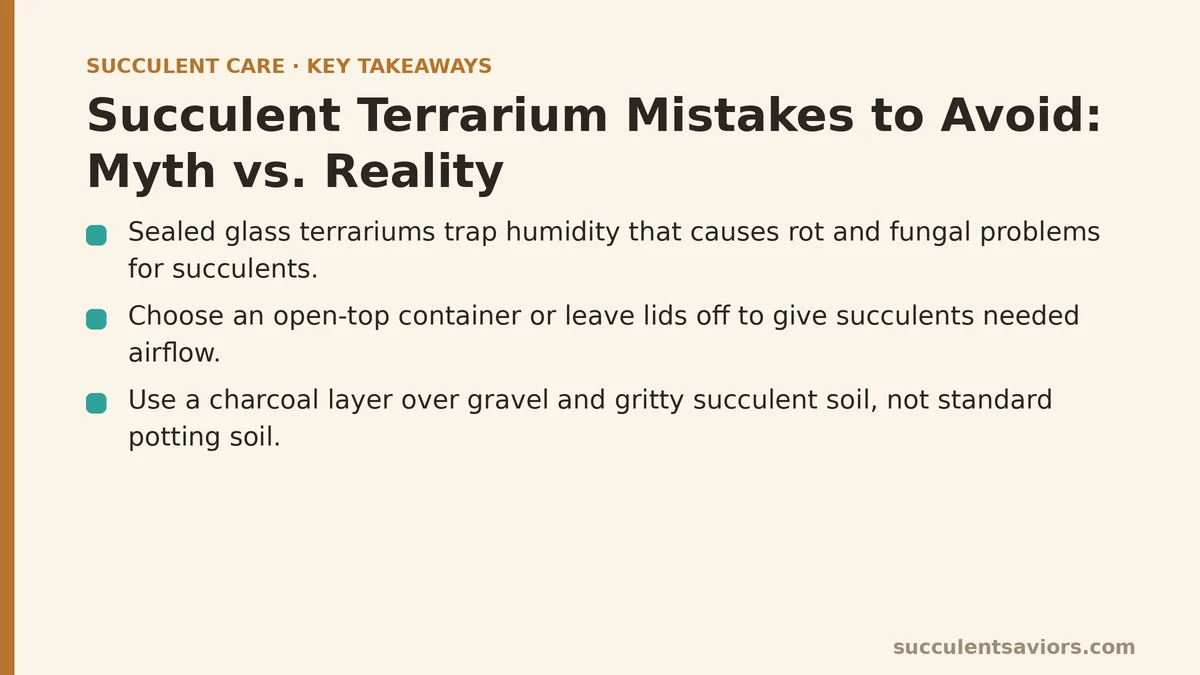
The Reality: Airflow matters more than shape. A sealed or mostly-sealed container traps humidity from the soil and any condensation, creating a microclimate that’s closer to a rainforest than a desert. Succulent roots and leaves sitting in that trapped moisture are prime candidates for rot and fungal issues within weeks.
What to Do Instead: Pick an open-top container, or one with a wide opening relative to its volume, whenever possible. If you’re set on a specific closed piece, plan to leave the lid off entirely or open it daily for several hours. Wide, shallow dishes and open glass bowls give succulents the air circulation their thick leaves need to avoid holding excess moisture against the skin.
Step 2: Build the Layers Correctly (Myth: A Drainage Layer of Gravel Fixes Everything)
Nearly every terrarium tutorial online recommends a bottom layer of pebbles or gravel to “hold excess water away from the roots,” especially in containers without drainage holes.
The Reality: This decorative gravel layer doesn’t function as true drainage. Water doesn’t disappear once it reaches the gravel; it sits there, and the saturated layer creates a reservoir of standing water directly beneath the soil. Capillary action then wicks that moisture right back up into the root zone, which means the “solution” is often quietly causing the very rot it claims to prevent.
What to Do Instead: The gravel layer isn’t useless, but it needs a partner: a thin layer of horticultural charcoal placed directly on top of it. Charcoal helps filter the water and reduces bacterial buildup and odor in a container with no true drainage. Above that, use a fast-draining, gritty succulent-specific soil mix, never standard potting soil, which retains far more moisture than these plants can tolerate.
Step 3: Get the Light Right (Myth: A Bright Room Is Bright Enough)
Terrarium photos often show these containers styled on bookshelves, desks, and coffee tables in rooms that look bright and cheerful. The assumption follows naturally: if a room looks sunny to human eyes, it must be bright enough for a sun-loving plant.
The Reality: Human eyes adjust to ambient light so effectively that we badly underestimate how dim most indoor spaces really are compared to what succulents need. A spot several feet back from a window, however sunny the room feels, often delivers a fraction of the light intensity required to keep a succulent compact and colorful. Inside a glass terrarium, that problem compounds, since the glass itself can filter and reduce incoming light further.
What to Do Instead: Place the terrarium within a foot or two of your brightest window, ideally one with several hours of direct or very bright indirect light daily. If that’s not achievable in your space, a small LED grow light positioned above the container for 8-10 hours a day will keep the succulents from stretching and fading. Rotate the container every few days so all sides get even exposure.
Step 4: Water With Restraint (Myth: Misting Keeps Succulents Happy in a Terrarium)
Because terrariums are so often marketed alongside tropical plants and moss, misting gets recommended as a gentle, low-risk way to keep everything hydrated.
The Reality: Misting wets the leaves without delivering meaningful moisture to the roots, where it’s actually needed. Worse, in an enclosed or poorly ventilated container, that surface moisture lingers on the leaves and in the crevices between rosettes, creating ideal conditions for rot and fungal spots. A light misting schedule can look like careful attention while quietly damaging the plant.
What to Do Instead: Water at the soil level, sparingly, using a small squeeze bottle or pipette to target the base of each plant. Let the soil dry out completely before watering again; in a terrarium environment, this might mean waiting three to four weeks between waterings, sometimes longer. Check by inserting a thin wooden skewer into the soil. If it comes out with damp particles clinging to it, hold off.
Step 5: Edit Your Plant Choices (Myth: Any Succulent Can Live in a Terrarium)
Terrarium kits and tutorials frequently mix succulents with air plants, mosses, and even small ferns, suggesting these groupings are compatible as long as they all look good together.
The Reality: Moss and ferns thrive in exactly the humid, low-light conditions that cause succulents to rot. Mixing plant types with opposing needs guarantees that someone in the arrangement is being cared for incorrectly at any given time. Succulents housed with humidity-loving companions are almost always the first to decline.
What to Do Instead: Keep your terrarium succulent-only, and lean toward slower-growing, smaller varieties that won’t quickly outgrow the container. Haworthia, small Echeveria, Sedum, and Crassula species tend to be more forgiving of the imperfect airflow and light conditions a terrarium presents compared to varieties that demand intense, direct sun.
Step 6: Monitor and Adjust Over Time (Myth: Set It Up Once and Forget It)
The “low-maintenance” reputation of terrariums leads many owners to assume the setup is a one-time task, something you arrange beautifully and then leave alone.
The Reality: A closed or semi-enclosed container is a small, sensitive ecosystem, and small ecosystems shift quickly. Condensation on the glass, a plant leaning toward the light, or a faint musty smell are all early signals that something needs attention before it becomes a full rot problem.
What to Do Instead: Check your terrarium every few days. Wipe away condensation and leave the container open longer if you see fogging on the glass. Remove any yellowing or mushy leaves immediately rather than waiting for your next scheduled check-in. Treat the terrarium as a living arrangement that needs occasional small corrections, not a permanent display piece.
Quick Reference: Terrarium Myth vs. Reality
| Common Myth | Reality | Correct Approach |
|---|---|---|
| Any glass container works | Sealed containers trap damaging humidity | Choose open-top or well-ventilated vessels |
| Gravel alone provides drainage | Gravel creates a hidden water reservoir | Add a charcoal layer and use gritty soil |
| A bright room is bright enough | Indoor light is far dimmer than it appears | Place near a window or add a grow light |
| Misting is a safe watering method | Misting causes rot without hydrating roots | Water sparingly at the soil level |
| Any succulent pairs well with moss or ferns | Mixed humidity needs guarantee neglect | Keep the terrarium succulent-only |
| Terrariums are “set and forget” | Small ecosystems shift quickly | Check in every few days and adjust |
If you’ve built a terrarium that’s held up for months rather than weeks, what turned out to be the deciding factor: the container you chose, the light, or how disciplined you were with watering? Related guides: Aeonium Care Guide: Troubleshooting Common Problems, Crassula Perforata String of Buttons Care Guide: Separating Myth From Reality, and Succulent Care Mistakes Travel and Nursery Professionals Make.