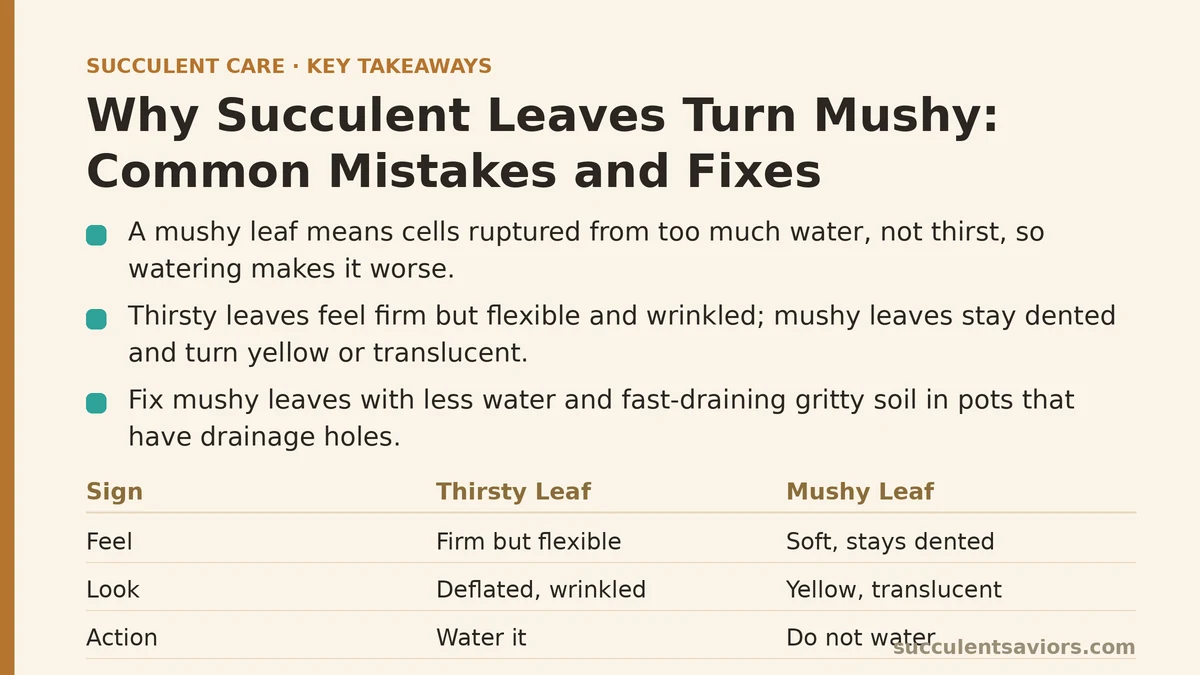
A mushy succulent leaf is not a sign of a plant that needs more water. It is the opposite. The most common reaction to a soft, sagging leaf is to water it, and that single instinct kills more succulents than any pest or disease. Mushiness means cells have ruptured from too much water inside them, and the tissue can no longer hold its shape or resist decay.
That counterintuitive fact is worth sitting with, because almost everything that follows depends on it. A shriveled leaf wants water. A mushy leaf wants the opposite: less water, drier air, and often a completely different soil mix.
Below are the questions readers ask most often when succulent leaves go soft, translucent, or yellow.
Is a Mushy Leaf Always a Sign of Overwatering?
Not always, but it is the cause the vast majority of the time. A leaf turns mushy when its cells take in more water than they can hold, swell past their limits, and burst. Once those cells are destroyed, the leaf loses structure and becomes a soft, wet-feeling bag of damaged tissue. You cannot reverse that.
The other causes are less common but worth ruling out:
- Freezing temperatures. A leaf exposed to frost will collapse and turn dark and soft within hours, often looking wet and glassy rather than just yellow.
- Physical damage. A leaf that was bumped, bent, or bitten can bruise and go soft at the injury site while the rest of the plant stays firm.
- Severe sunburn after watering. Water droplets on a leaf in strong direct sun can scorch tissue, and the damaged spot softens as it dies.
The useful test is location and spread. Overwatering mushiness usually starts at the base of the plant near the soil line and spreads upward. Cold damage tends to hit the outermost or most exposed leaves first. Bruising stays local and does not progress.
What Does Mushy Look Like Compared to Just Thirsty?
Distinguishing these two states is the single most important skill in succulent care, and it takes about thirty seconds to learn by touch.
A thirsty succulent leaf is firm but flexible. It may feel slightly rubbery, and it will look deflated or wrinkled, with the surface losing its tight, plump sheen. Color usually stays normal or gets a little duller.
A mushy leaf is soft and yielding, with no spring back. Press it gently and it stays dented, or it feels like a water balloon under too much pressure. Color shifts to yellow, translucent, or brown, and the leaf often detaches from the stem with almost no resistance. If it smells sour or earthy-foul, decay is already well underway.
Here is the practical rule: if you have to press to tell, water it. If it gives way on its own, do not.
What Soil and Pot Mistakes Cause Mushy Leaves?
Water sitting around the roots is the root of the problem, and two setup choices drive it more than anything else.
Soil that holds moisture. Standard potting mix is designed to stay wet, which is the opposite of what succulents need. A proper succulent mix is gritty and fast-draining, typically a blend of potting soil, coarse perlite or pumice, and coarse sand. A useful visual benchmark is that water poured through should exit the drainage hole within seconds, not minutes. If your mix stays dark and damp for days, that is your first fix.
Pots without drainage, or with the wrong material. A pot with no drainage hole traps water at the bottom no matter how careful you are. Beyond that, the material matters:
- Terracotta is porous, so it wicks moisture out through the walls and dries fastest. This is the most forgiving option for a beginner or an overwaterer.
- Glazed ceramic looks better but holds water longer, so you need to water less often.
- Plastic retains moisture the longest and warms quickly in sun, which suits growers who tend to underwater but punishes anyone who does not.
If you are not sure which camp you fall into, start with terracotta. It gives you a larger margin for error.
Watering Frequency or Watering Volume — Which One Matters?
Frequency is the culprit almost every time. Succulents are adapted to soak up a large amount of water at once and then go dry for an extended period. Giving them a small amount often keeps the soil perpetually moist, which is the exact condition their roots cannot tolerate.
The fix is a full soak followed by a complete dry-out. Water thoroughly until it runs out the drainage hole, then wait. Do not water again until the soil is dry all the way through, which you can confirm by inserting a wooden skewer and checking whether it comes out clean and dry.
How long that takes depends heavily on your conditions:
- Summer, outdoors, terracotta: often three to seven days.
- Indoors near a bright window, spring or fall: commonly one to two weeks.
- Winter, low light, cooler room: frequently three to four weeks, and some succulents need no water at all.
Calendar-based watering is where most people go wrong. The schedule in your head does not know how fast your particular pot dried out this week.
Can a Mushy Succulent Be Saved?
Yes, if the rot has not reached the core of the plant. Here is how to tell, and what to do.
Check the stem. A healthy stem is firm and solid. If it is soft, dark, and squishy, the rot has moved past the leaves and into the main body. At that point, the original plant is gone, but you can still salvage it.
If the stem is firm but leaves are mushy: remove every soft leaf, repot into fresh dry gritty mix, and hold off watering for a week to ten days. Then resume the soak-and-dry cycle with a longer dry interval than before.
If the stem is soft: cut the plant above the rot with a clean, sharp blade. Keep cutting upward in small increments until the cross-section is clean, pale, and firm with no dark streaks. Let the cutting callus in a dry, shaded spot for several days until the cut surface has hardened and skinned over. Then place it on dry gritty soil and wait — do not water until roots form, which typically takes two to four weeks.
If the whole plant has collapsed: you can still propagate from any leaf that is not soft. Twist a healthy leaf off cleanly, let it dry for a few days, and lay it on dry soil. Leaf propagation is slow but reliable, and it is a much better outcome than losing the plant entirely.
One caution: do not compost or reuse the old soil. It carries the pathogens that caused the rot.
How Do I Stop This From Happening Again?
Four habits prevent most cases of mushy leaves.
- Repot new plants. The soil they arrive in is usually moisture-retentive nursery mix. Move them into gritty mix within a week or two of bringing them home.
- Water by feel, not by calendar. Check the soil with a skewer or by weight — a dry pot feels noticeably lighter than a freshly watered one.
- Match watering to the season. Cut back sharply in winter when light is low and growth has slowed. This is when overwatering does the most damage because the plant is barely using water.
- Watch the base of the plant. The soil line is where trouble shows up first. A quick weekly glance at that spot catches early softness before it spreads.
Quick Reference: Mushy Leaf Symptoms and Fixes
| What You See | Most Likely Cause | What To Do |
|---|---|---|
| Soft, yellow, translucent leaves near the soil line | Overwatering and early root rot | Remove affected leaves, repot in dry gritty mix, delay watering |
| Dark, wet-looking leaves after a cold night | Freezing damage | Move indoors, remove damaged leaves, protect from further cold |
| Localized soft spot with no spread | Bruising or injury | Leave it; the leaf will dry and drop on its own |
| Soft stem with dark streaks | Advanced rot | Behead above the rot, callus, and re-root |
| Whole plant collapsed, soft throughout | Severe rot, past saving | Propagate from any remaining healthy leaves |
The takeaway is simple and worth repeating: mushy means too much water, not too little. When in doubt, do nothing for a few days. Succulents tolerate a missed watering far better than an extra one, and the plant you are worried about is usually asking for dryness, not a drink.
Have you ever watered a mushy succulent hoping to perk it up — only to watch it decline faster? What did you change the second time around?
Related guides: Succulent Leaves Turning Translucent and Mushy: 5 Causes Ranked From Most to Least Likely, How to Identify Succulent Root Rot Early, and Common Mistakes Diagnosing Succulent Sunburn vs Overwatering Symptoms.